by Katrina Pinili, 6th year Ph.D. candidate, Gibbs Lab, University of Nevada, Las Vegas
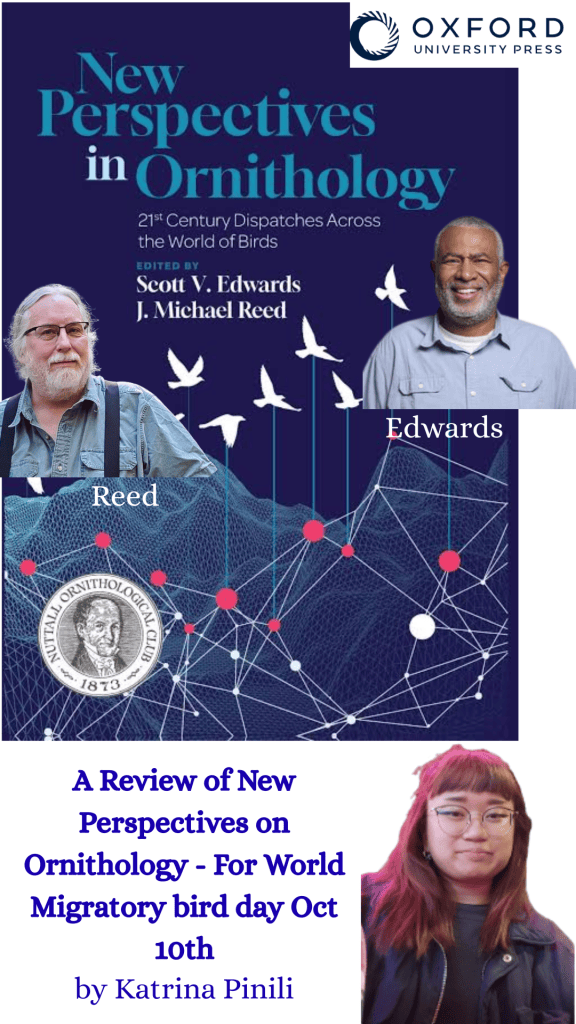
In this blog, I review an encylopedia-esque book on ornithology, the scientific study of birds. Authors Scott V. Edwards and J. Michael Reed give us an updated version of Perspectives in Ornithology by Alan Brush and George Clark (published in 1983), New Perspectives in Ornithology. This updated book is divided into 5 sections: ecology, evolution, behavior, databases and citizen science, and conservation and management, where each section is contributed by a handful of bird scientists that are experts, offering insightful information on each topic regarding birds.
Reading through this book, I appreciated the casual commentary from the authors as opposed to very dense literature reviews published in modern science today. Each scientist contributed their own views on each topic, while also supporting and commending the views of other fellow contributors of this book, and summed everything up with the chapter’s context to future scientific endeavors. As an entomologist, I enjoyed learning something new that is not directly related to my field, yet allowed me to think about how I can apply this information to my current career and my own research interests. Below, I provide quick commentary for each section of New Perspectives in Ornithology, especially the fascinating factoids I learned and appreciated along the way.
Section I: Ecology
This first section of the book discusses the dispersal of bird populations, which also ties into their “annual cycle”, various phases of a bird’s breeding and movement behaviors. Reading through these chapters, it made sense to me that there are a lot of factors that can directly or indirectly affect a bird’s annual cycle, such as climate, habitat availability, food resources, and anthropogenic activities. New technology has attempted to track birds in the different stages of their cycles, but because annual cycles can occur over many years, scientists only observe a window of time in these birds.With these concerns to birds’ annual cycles, conservation methods should be created to help prevent the loss of bird biodiversity.
Various questions regarding movement ecology were also mentioned here, such as physiological diving responses and migratory mechanisms across bird species, as well as the invasion of birds in new locations. Overall, this section provides a great introduction into the rest of the book, while also providing sufficient background on how dispersed birds are throughout the world.
Section II: Evolution
Much of this section pertains to the phylogeny of early birds as well as the rise of modern birds in which the authors go into great detail of how different species could be related. Through fossils, scientists have linked morphology to potential behaviors, especially those that existed in the Late Jurassic period. The example of Charles Darwin’s Galapagos finches was used, a popular topic that is often mentioned in introductory biology textbooks and lectures. The finches he studied had different beak shapes, indicating that each beak meant a specialization of a certain type of food (e.g. seeds, bugs, etc.). With this, hypotheses of speciation were mentioned by the authors, another fascinating theme of how birds became so diverse over time.
This section also takes us on a journey through the diversification of species in South America, postulating various hypotheses on how such diverse and beautiful organisms come about in the Andes and the Amazon regions. I will not list each hypothesis here, but each one was strongly supported by evidence which showed theopen-mindedness of the possible reasons for such a large diversity of birds. It also gives the reader a chance to understand that ornithologists, and scientists in general, have very diverse fundamental backgrounds and their own perspectives on any topic.
I particularly enjoyed reading Chapter 11: Natural History Collections because it gives the reader insight into how museums actually came to be, and how much scientific impact that preserved specimens can offer to scientists and the general public. I was reminded that specimens were collected as a sort of treasure for voyagers in the 1500s, which eventually established the desire to curate specimen collections by the end of the 19th century. I liked learning about the history of specimen collecting and how this hobby eventually became integral to science and our understanding of birds as well as other species. The collection of birds not only linked phylogenetic relationships, but it also informed researchers of the potential diseases and environments that these specimens interacted with, which I thought was very interesting! Overall, I thought this section is a very structurally important theme in ornithology, especially its historical roots in understanding bird evolution.
Section III: Behavior
This section highlights the different technologies and methods that are used to study behavioral patterns of birds such as passive integrated transponder (PIT) tags and GPS tagging. But this section also emphasizes that, in the end, behavior is just a complicated topic to study despite having these technological advancements. I studied mating behavior during my undergraduate studies and could relate to how difficult behaviors can be measured and analyzed as described throughout this section. For example, it was discussed in Chapter 13 that data collection may have skewed our understanding of bird behavior just because of the convenience in location, e.g. only studying birds in their nest, which neglects the data that could be collected in other habitats and geographic locations. I agree with the author that stresses the importance of collecting data not only from common locations and highly populated areas but also from locations that are less noticed and admired.
The term “bird brain” was mentioned, one that I had not heard in a long time, yet is only reflective of how early ornithologists viewed birds. However, after reading this section, I knew that birds no longer fall under this term, since more recent data shows just how complex birds really are: they have precise communication through songs, some species have multilevel societies (seen in the Vulturine Guineafowl), and they maintain familial relationships.
This section was very eye-opening, bringing awareness to show how amazing birds are through their diverse abilities to communicate with one another via songs and feather coloration. Here’s an interesting question that I had not thought about until reading this book: have you ever seen migratory birds that are brightly colored in the sky? I certainly haven’t! The reason is that migratory birds typically have lightly colored plumage which helps them survive long flights (the lighter the color, the lesser the heat exhaustion from the sun, and thus, less energetic demand!). This was definitely a refreshing section to read, especially if you are curious about how birds communicate, as well as the underlying genotypes that facilitate these social interactions.
Section IV: Databases and Citizen Science
I was amazed to learn that thousands of people have contributed to our knowledge of birds, typically through eBird, a global database compiled by many bird-lovers and volunteers around the world. I felt proud that the common citizen, whether that be your next door neighbor or the person who helped you at the grocery store, has the opportunity and ability to make lasting impacts on ornithologists’ research and future studies simply by observing birds in the wild.
Although the science of the citizens have contributed a lot of data to public databases, I found it interesting to learn that community-based ornithological projects can be skewed based on where the data is being collected. Because of this unfortunate bias, we lose potential data from underrepresented communities and their impacts on our current knowledge. Chapter 25 (in Section V) is an example of losing important data, where it is mentioned that South African ornithologists are less likely to publish their findings due to financial constraints and acceptance bias from journals. As a scientist, findings should be accepted and supported in order to increase our understanding in science because we end up with gaps in knowledge even though the data is there, but it is neglected.
Citizen science has made a great impact in ornithology through eBird, and I am proud of the different communities that contribute to our avian database. This section impacted me in a way that goes beyond data collection; I feel for underrepresented communities not being heard, and I also encourage supporting your peers and their research, regardless of it being part of citizen science or being unpublished.
Section V: Conservation and Management
A giant chunk of this last section of the book, and rightly so, highlights the increasing global importance in the conservation of birds; ways to manage conservation and also awareness of declining bird species are important in the field of ornithology, which can be applied to other species as well. I was moved by how much care was taken into writing this section, the care for the wellbeing of birds, and how we can lessen the damage to the birds that are a part of our everyday lives. This section also emphasizes maintaining stable and improved production of chickens as livestock in rural areas of the world, highlighting the ways in which the government, scientists, and farmers can communicate in order to learn from each other and improve the sustainability of chickens.
My concluding thoughts:
As I read through this book, I realized that for a handful of hypotheses, modern technology like genomic sequencing and GPS trackers can only do so much. As each chapter concludes, the author(s) provide insight into how we can improve our understanding of bird diversity, which was always left with a nice and hopeful message for young and future scientists.
I am also stuck on the common theme that the study of birds is typically rooted in history and social biases, and did not start as a research objective at all. For example, in Chapter 11, curating biological specimens for museum collections began because of sailors and adventurers in the early 1500s, where specimens were collected, admired, or sold. Over time, scientists like Linneaus and Brisson propelled this pastime as a source of knowledge, specifically avian knowledge, in the 18th and 19th century. Now, the museums we see today, like the Smithsonian National Museum of Natural History, display a wide variety of specimens. It is amazing to know that this all started as a simple activity. Another example is in Chapter 14, where birdsongs are canonically viewed as a male trait, but this has come to be because of historical biases: most early scientists were male and only perceived male birdsongs as novel, dismissing the possibility of female birdsongs completely. However, this is not true; many species of female birds, depending on the geographic location, also take part in singing, and they have actually been singing just as long as males have. Simply, this historical bias was established because of who was researching birdsongs.
I learned that each chapter is not only a commentary on various aspects of birds, it is also a commentary on human historical behavior and how our actions affected the ways in which we collect data. This book opened my eyes to how humans played a large role in data acquisition way before the establishment of many scientific fields. Upon finishing this book, I believe that not only bird-lovers should have this book on their bookshelf, but especially ecologists and those who care about how we obtain data from the wild. There is so much to learn about our impacts, our technological advancements, and our own perspectives that was discussed in this book, and we can use this knowledge to broaden our horizons into each of the fields we study.

Katrina Pinili is a 6th year Ph.D. candidate in the Gibbs Lab at the University of Nevada, Las Vegas. She is studying starvation-selected Drosophila melanogaster with a focus on how exercise affects their metabolism and physiology. In her spare time, she loves doing arts and crafts and playing video games. She loves animals; she has 2 cats and a brazilian short-tailed opossum!
connect via
Linkedin: https://www.linkedin.com/in/katrina-pinili-02797a187/
& be sure to read
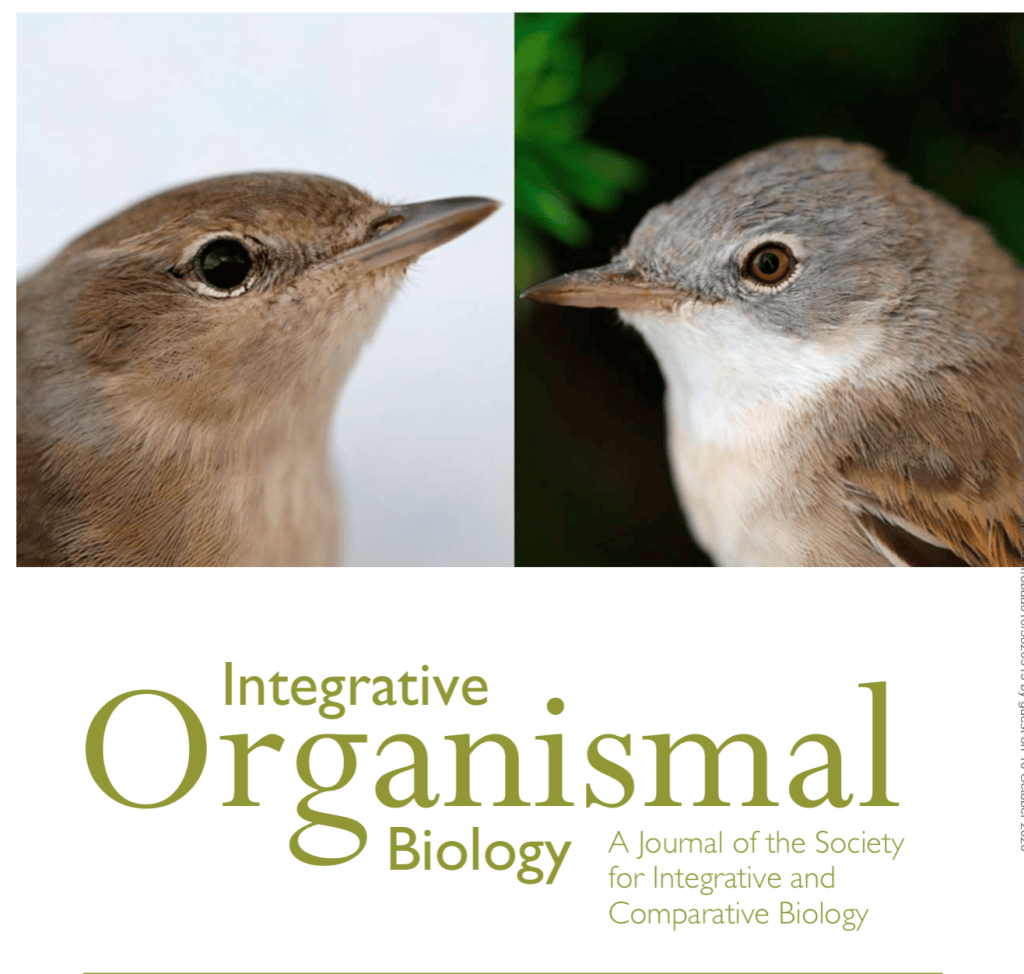
Energy Stores, Oxidative Balance, and Sleep in Migratory Garden Warblers (Sylvia borin) and Whitethroats (Sylvia communis) at a Spring Stopover Site

