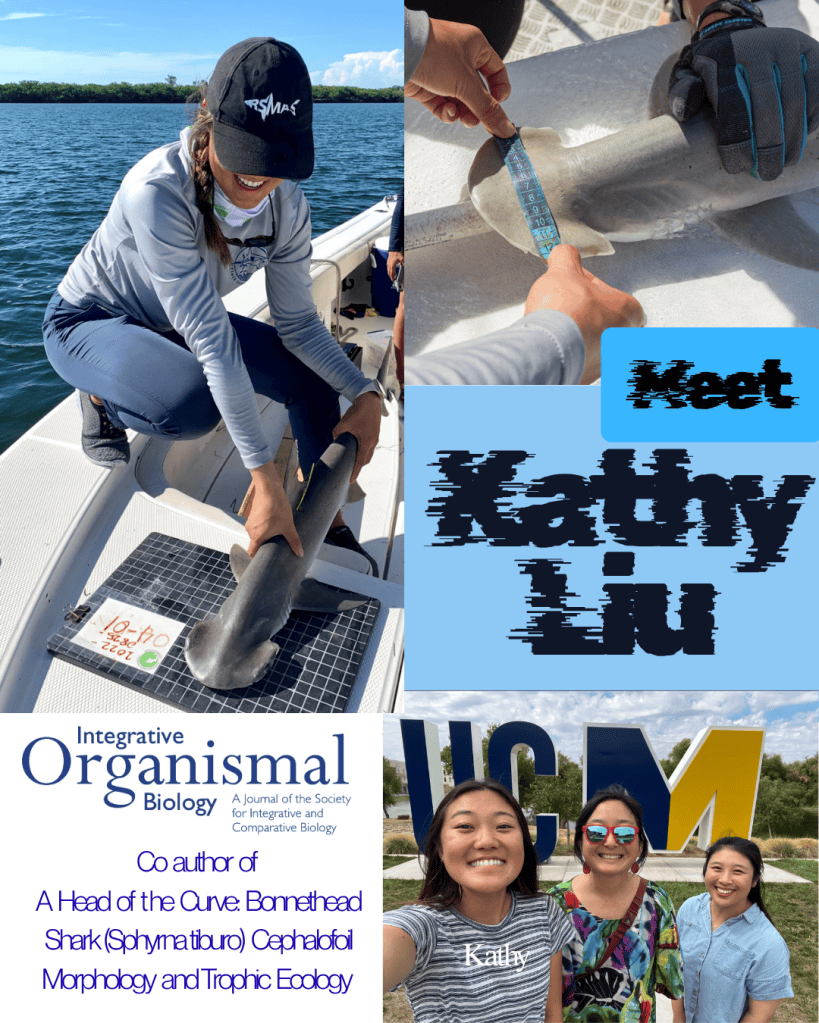
Kathy is the co author of
A Head of the Curve: Bonnethead Shark (Sphyrna tiburo) Cephalofoil Morphology and Trophic Ecology
K Liu , J R Graham , H Ro , S L Kim , T R Wiley , J M Gardiner , L J Baker , C Macdonald
https://doi.org/10.1093/iob/obag024
below she details a bit about her scientific journey, influences and work:
Tell us a bit about your scientific journey?
My love of nature and exploring the outdoors developed growing up in the mountains of Utah. Being from a landlocked state, I didn’t spend much time around the water or have many opportunities to learn about marine sciences, but I was always interested in biology and ecology. During college, I was able to spend a semester around Panama with SIT learning about tropical ecology, marine ecosystems, and biodiversity conservation and the vast variety of research in those fields. It was an incredible opportunity to be in each ecosystem as we learned and implemented various methodologies to conduct our own research projects. As we went from cloud forests to urban natural parks to island archipelagos, my love of hands-on research flourished. The more time we spent in mangrove forests, seagrass beds, and coral reefs, the more my interest in those coastal habitats grew. For my end of semester independent project, I chose to continue exploring those areas and studied reef fish diversity and distribution in seagrass and coral reef habitats off Isla Bastimentos. Days were spent kayaking, snorkeling, and readjusting schedules around the torrential downpours of the rainy season. I loved being able to play around with data visualization and seeing the collected data culminate into a final publication.
My path in science then brought me to Chile to study intertidal grazers, to Australia to offer support with fish ID in seagrass habitats, and to remote areas of Utah with the Division of Wildlife Resources surveying trout and other native species, before leading me to Miami for my Master’s degree. My time at the Rosenstiel School of Marine, Atmospheric, and Earth Science of the University of Miami (UM) not only allowed me to take more courses in marine science and conservation, but also gave me the opportunity to get AAUS scientific diving certified and my small boat operator certification. Now living by the water, I tried to maximize my marine experiences and volunteered with sea turtle nesting and horseshoe crab surveys and worked at a local dive shop. This gave me varied additional experiences in addition to shark tagging and collecting data for my thesis working with the wonderful people of Field School and the UM Shark Research & Conservation Lab. Following my Master’s, I spent a year in Savannah, Georgia as a fellow with Gray’s Reef National Marine Sanctuary contributing to not only the science team but also working closely with education & outreach and resource protection.
I’m a strong believer that your professional path does not have to be linear and that it’s incredibly beneficial to explore a variety of things to figure out what interests you and what you want to focus your time on.
Who were your major influences(and detail a bit about how they influenced you)?
I’ve been mentored by many incredible women in STEM throughout my career. These individuals have continued to inspire me to think innovatively and to create spaces for those who are often traditionally underrepresented.
When I was entering into marine science, Dr. Evie Wieters and Dr. Adriana Vergés not only welcomed me into their labs in Chile and Australia, respectively, but also fostered incredible learning environments encouraging me to ask questions and get involved in a variety of projects. They made me feel supported as I explored both my interests in marine sciences and these incredible places that I was working in.
As I progressed through my Master’s degree, working with Dr. Catherine Macdonald and her team at Field School was an unbelievable privilege. I am constantly in awe of how eloquently Dr. Macdonald is able to convey information and how digestible she is able to make a variety of complex course topics, which I hope to emulate as I advance in my career. I am eternally grateful for her dedication to her work and her students.
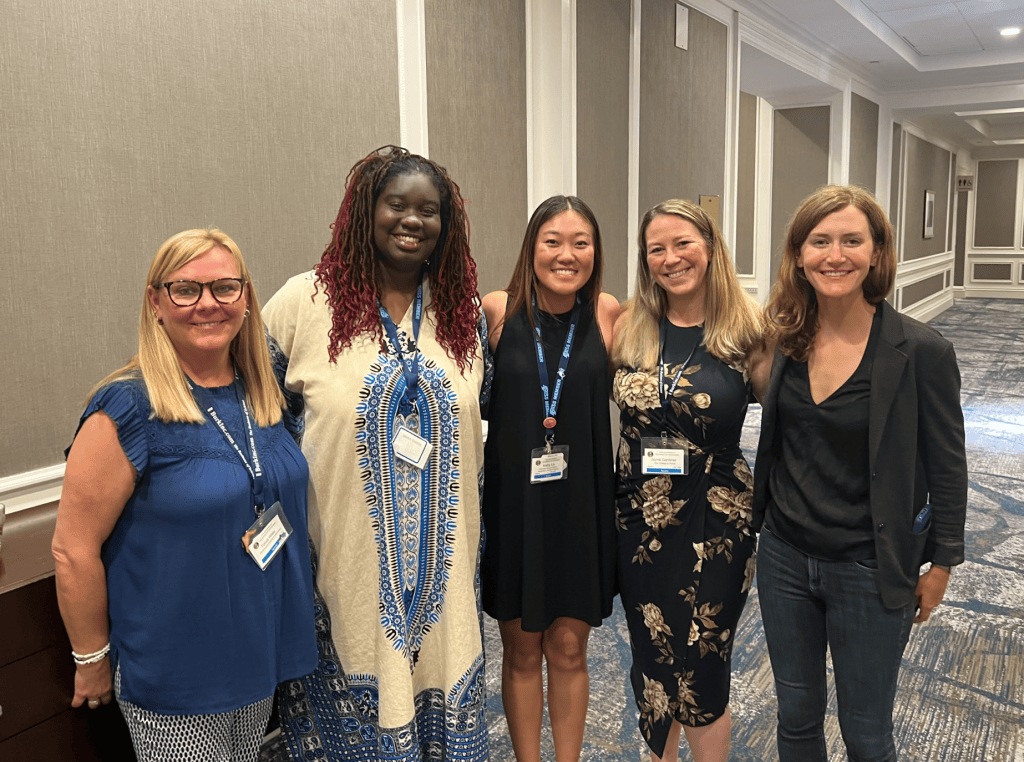
Finally, I am also always looking up to the co-founders of Minorities in Shark Sciences (MISS), Jasmin Graham, Jaida Elcock, Carlee Jackson, and Amani Webber-Schultz, who created a community to support representation of gender minorities of color in shark science. The incredible community of MISS has not only provided opportunities to present my science at conferences, but also fostered friendships as I navigate being a scientist, and allowed me to mentor others and get to share the skills and knowledge I’ve learned thus far.
Can you detail for a us a bit about how you landed on researching shark morphology?
This project sparked from one of science’s most frequently asked questions of “why is that thing the way that it is?” One of our co-authors, Jasmin Graham, who has studied bonnetheads in Tampa Bay, came to Miami to help with sampling in Biscayne Bay and immediately asked why our bonnetheads were “weird”. We weren’t sure what she was talking about and learned that in comparison, the Biscayne Bay bonnetheads were smaller, paler, and frailer than the ones she was used to seeing. This sparked all of our interests. Bonnetheads are one of the most commonly caught species in our Biscayne Bay sampling and Jasmin was seeing that trend across all the ones we tagged. Following this revelation, I joined Jasmin and our Tampa coauthors with shark surveys in Tampa Bay, where we were able to catch some bonnetheads which to me were “big beefy bonnets”, but then to Jasmin, they were very normal sized.
We wondered if some of these differences were environmental, as Tampa Bay water is more turbid and Biscayne Bay water is fairly clear, but were also curious what the differences in morphology were as we already take a lot of body measurements. Bonnetheads are unique in that their head (called a cephalofoil in hammerhead species) shape is sexually dimorphic with males and females exhibiting statistically significantly different head shapes with no known reasoning. This dimorphism has not been documented for all bonnethead subpopulations and was something we wanted to explore further in addition to the measurements and biological samples we were collecting. I created our bonnethead board as a quick way to capture photos of the heads that we could analyze later that would allow us to continue to conduct quick workups and releases of each animal.
I learned a lot of new skills including ImageJ which we utilized to measure bonnethead cephalofoil photos in addition to stable isotope analysis with the help of our coauthors from the University of Merced. Being able to combine morphological analyses with diet was very exciting to explore possible correlations and to give us a snapshot of the Biscayne Bay bonnetheads that had not been studied in depth previously.
More about Kathy:
Kathy Liu is a marine biologist and shark scientist with a passion for fieldwork and photography. She’s loved exploring various aquatic habitats and coastal shallow marine environments through her prior roles. Her previous work includes reef fish distribution in Panama and intertidal grazer diversity and allometry in Chile. She is currently exploring her next steps and excited to see where her future endeavors take her.

