by Laura Sisk-Hackworth, Jennie E. DeVore, Sarah A. Muh, Landon B. Porter, Hans A. Hofmann, Department of Integrative Biology, The University of Texas at Austin
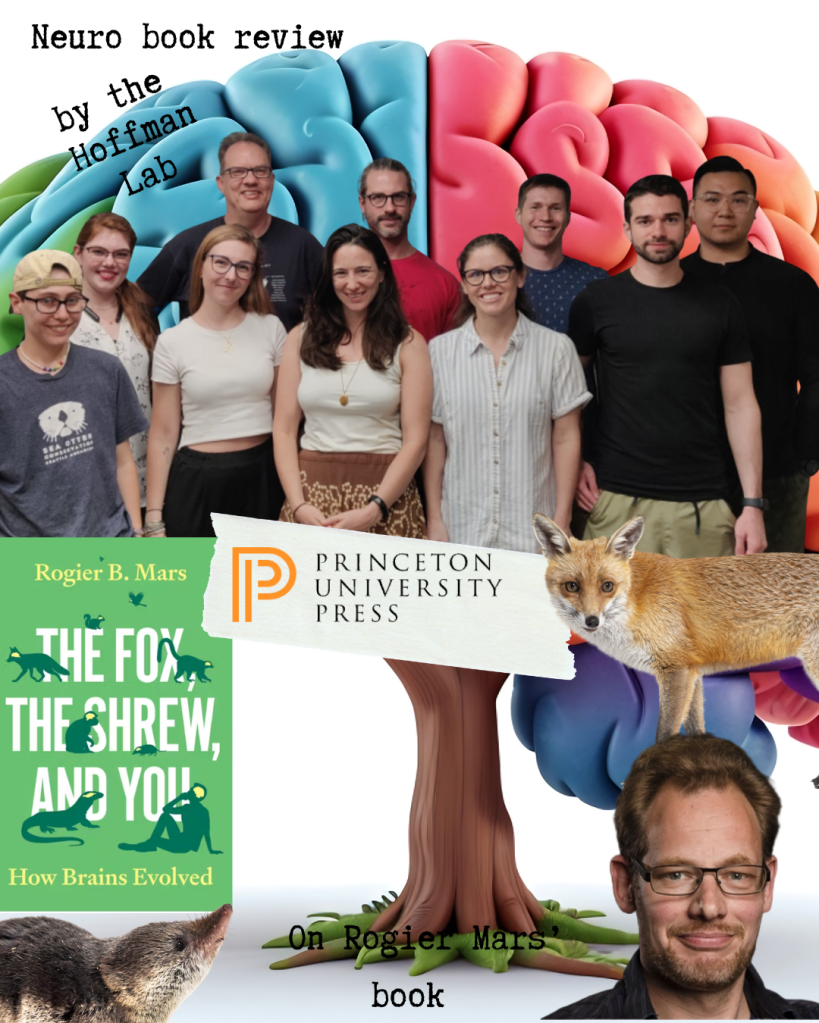
It has often been claimed that the human brain is the most complex system in the universe, yet how this complexity evolved is still a topic of intense discussion today (Pollen et al., 2023; Striedter & Northcutt, 2020). In his book “The Fox, the Shrew, and You,” Rogier Mars, a neuroscientist at Oxford University, explores the evolutionary origins of human brain evolution, highlighting lessons from species spanning sea squirts (why have a brain?), shrews (how did nocturnal life amid the dinosaurs shape the mammalian neocortex?), and simians (why might fruit-based diets have led to a large prefrontal cortex? ). Mars sets the stage with a short introduction to evolution and the comparative approach in biology before taking us on an enlightening journey through diverse species and key studies that give us insight into human brain evolution. Many of the animals featured are mammals, which is not surprising given the framing of the book around human brain evolution — a framing that proves to be both a strength and a limitation. To his credit, however, Mars often goes into great detail about the natural history of these animals, the scientific studies, and the historical and scientific context. The book contains many fascinating evolutionary tidbits that an enthusiast or student is sure to love: “It is likely that no animal bigger than 25 kilograms survived [the K-T extinction]” (p. 51)
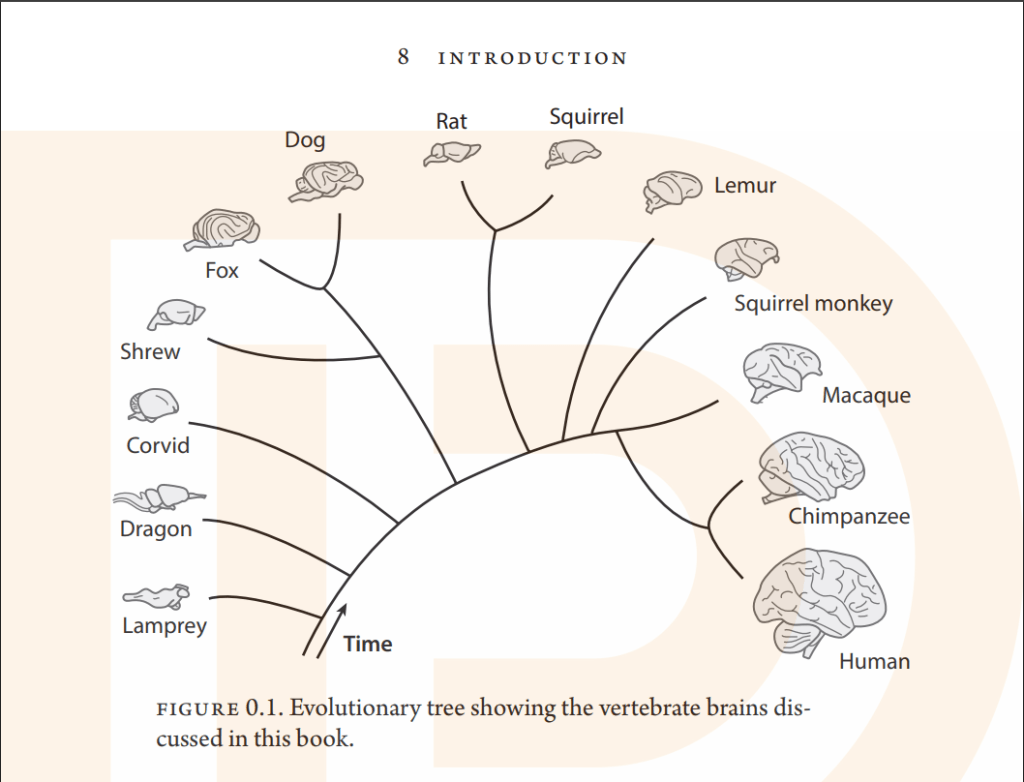
For reasons that are not entirely clear, the book focuses almost entirely on foraging as the primary driver of brain evolution. Other well-known factors shaping brain evolution – among them sexual selection, social behavior, thermoregulation, and developmental constraints – are touched on only briefly, if at all. This is surprising, as comparative analysis of brains through the lens of other important selection mechanisms can provide important insights. Although Mars is careful to disclaim scala naturae — “This is not because we humans are in any way the pinnacle of evolution or that we are more evolved than any of the other brains we discuss” (p.13) — the book’s structure undercuts him. Each chapter walks us “up” the evolutionary tree towards humans with occasional asides (“There is something strange about humans” (p. 147), “Yes, humans are the only species that has spoken language” (p. 150) — the whale biologists may disagree) that appear to reinforce this hierarchy. Nevertheless, Mars does a great job of dispelling simplistic myths about “bird brains” or “lizard brains,” and is clear that “nonhuman animals are capable of much more complex ‘humanlike’ behavior than we originally thought.” (p. 149) The intent to situate humans within a comparative framework is there; it’s the book’s organization that fights it.
Over the past couple of decades, modern ‘omics and transgenic approaches (Song et al., 2026) along with ever increasing datasets amenable to phylogenetic comparative analyses (Logan et al., 2018) have revolutionized our understanding of the developmental and physiological mechanisms of brain evolution, yet these exciting advances are omitted or receive only passing mention. Similarly, broad syntheses aimed at explaining the diversification of ancient brain structures over hundreds of million years, such as the neuromeric model (Puelles & Rubenstein, 2003) or the social behavior decision-making network (O’Connell & Hofmann, 2011, 2012) are not discussed at all. These shortcomings aside, the book succeeds with an engaging writing style and a sense of humor: “The sea squirt is not an attractive animal. It goes by the charming Latin name of Ciona intestinalis (pillar of intestines), and, quite frankly, that is not a bad choice given the looks of an adult sea squirt.” (p. 15)
The book occasionally takes the reader on unexpected journeys into scientific rabbit-holes, but these digressions are part of its charm. Mars is at his best when he delves into the history of brain evolution itself, explaining discoveries in context of the research teams involved, details of scientific experiments, and how scientific questions were developed. This opens a compelling window into the scientific process: “This is precisely what the neuroscientist Suzana Herculano-Houzel thought. She had been puzzled by the fact that neuroscientists often quote the number of neurons in the human brain as about 100 billion, but there actually seemed to be very little data to prove that number.” (p. 74)
We noticed that only 13 of the 72 scientists (by our count) mentioned in the book are women. This is not necessarily a criticism of the author since for much of history women were excluded from science, or their contributions were downplayed or misattributed. However, many of the scientists mentioned are still active, and quite a few of the leading figures in the field of brain evolution today are women. While the book does a good job of answering the question it initially poses (“How do all these brains relate to our own?” (p. 1)), the foraging frame that organizes its first chapters is never fully justified, leaving the reader unsure whether foraging is meant as the primary driver of brain evolution or as a didactic device for illustrating exaptation. Even so, this is an engaging book, well suited for biology students and lay biology enthusiasts. We would be happy to suggest this book to friends and students interested in brains, behavior, natural history, and comparative biology.
References:
Logan, C. J., Avin, S., Boogert, N., Buskell, A., Cross, F. R., Currie, A., Jelbert, S., Lukas, D., Mares, R., Navarrete, A. F., Shigeno, S., & Montgomery, S. H. (2018). Beyond Brain Size: Uncovering the Neural Correlates of Behavioral and Cognitive Specialization. Comparative Cognition & Behavior Reviews, 13. https://comparative-cognition-and-behavior-reviews.org/vol13_logan_et-al/
O’Connell, L. A., & Hofmann, H. A. (2011). The Vertebrate mesolimbic reward system and social behavior network: A comparative synthesis. Journal of Comparative Neurology, 519(18), 3599–3639. https://doi.org/10.1002/cne.22735
O’Connell, L. A., & Hofmann, H. A. (2012). Evolution of a Vertebrate Social Decision-Making Network. Science, 336(6085), 1154–1157. https://doi.org/10.1126/science.1218889
Pollen, A. A., Kilik, U., Lowe, C. B., & Camp, J. G. (2023). Human-specific genetics: New tools to explore the molecular and cellular basis of human evolution. Nature Reviews Genetics, 24(10), 687–711. https://doi.org/10.1038/s41576-022-00568-4
Puelles, L., & Rubenstein, J. L. R. (2003). Forebrain gene expression domains and the evolving prosomeric model. Trends in Neurosciences, 26(9), 469–476. https://doi.org/10.1016/S0166-2236(03)00234-0
Song, J. H. T., Greenberg, M. E., Reich, D., & Walsh, C. A. (2026). Genomic approaches for understanding the evolution of the human brain. Nature Neuroscience, 29(5), 1036–1047. https://doi.org/10.1038/s41593-026-02277-1
Striedter, G. F., & Northcutt, R. G. (2020). Brains Through Time: A Natural History of Vertebrates. Oxford University Press.
Connect with author Rogier Mars:

Connect with the Book Review author bios
Author Bios

Laura Sisk-Hackworth
Website : https://www.lsiskhackworth.com/
LinkedIn: https://www.linkedin.com/in/laura-sisk-hackworth/
Laura is a molecular and computational biologist interested in how genes, proteins, and hormones control organisms’ interactions with the environment and microbes. After she received her Ph.D. from the University of California San Diego and San Diego State University, she joined The University of Texas at Austin as a postdoctoral fellow. Outside of the lab, she enjoys hitting the trails, reading, and playing pop songs on the piano.
Jennie DeVore
“Jennie is a graduate student in Ecology, Evolution & Behavior at The University of Texas at Austin, studying the behavioral and neural underpinnings of bumblebee construction behavior.”
Sarah Muh
LinkedIn www.linkedin.com/in/sarah-a-muh
Sarah is a PhD candidate at the University of Texas at Austin. There she studies the neuromolecular mechanisms of collective animal behavior using a “multi-omics” approach and with a focus on fish shoaling behavior. In her free time, she enjoys dance, crafts, and volunteering at the local bunny shelter.

Landon Porter
Website : https://landon-port.netlify.app/
Landon is a PhD candidate in Ecology, Evolution & Behavior at The University of Texas at Austin, where he studies the molecular and transcriptomic basis of social behavior in cichlid fish. His broader interests span comparative neuroscience and vertebrate brain evolution. Landon is also passionate about teaching biology and spending time outdoors.

Hans A. Hofmann
Lab website: https://sites.utexas.edu/evoneuro/
LinkedIn: https://x.com/HofmannLab
Twitter: https://www.linkedin.com/in/hans-a-hofmann-55a6272/
Hans is a professor of Integrative Biology and Neuroscience at The University of Texas at Austin. His interests center on the neural, molecular, and genomic basis of social behavior and its evolution. Over the years, he has led several initiatives within and outside the university to further progress and education in the integrative biology of brain and behavior, in bioinformatics, and in biomedical research support. He has worked to transform entry-level biology laboratory education through multimedia and web-based instructional tools. Finally, He is dedicated to engaging the public about his research and integrative biology in general, and to introducing public engagement training into graduate and postdoctoral education.

