Andrea Jivanny Hernandez Ramirez, Hamilton College
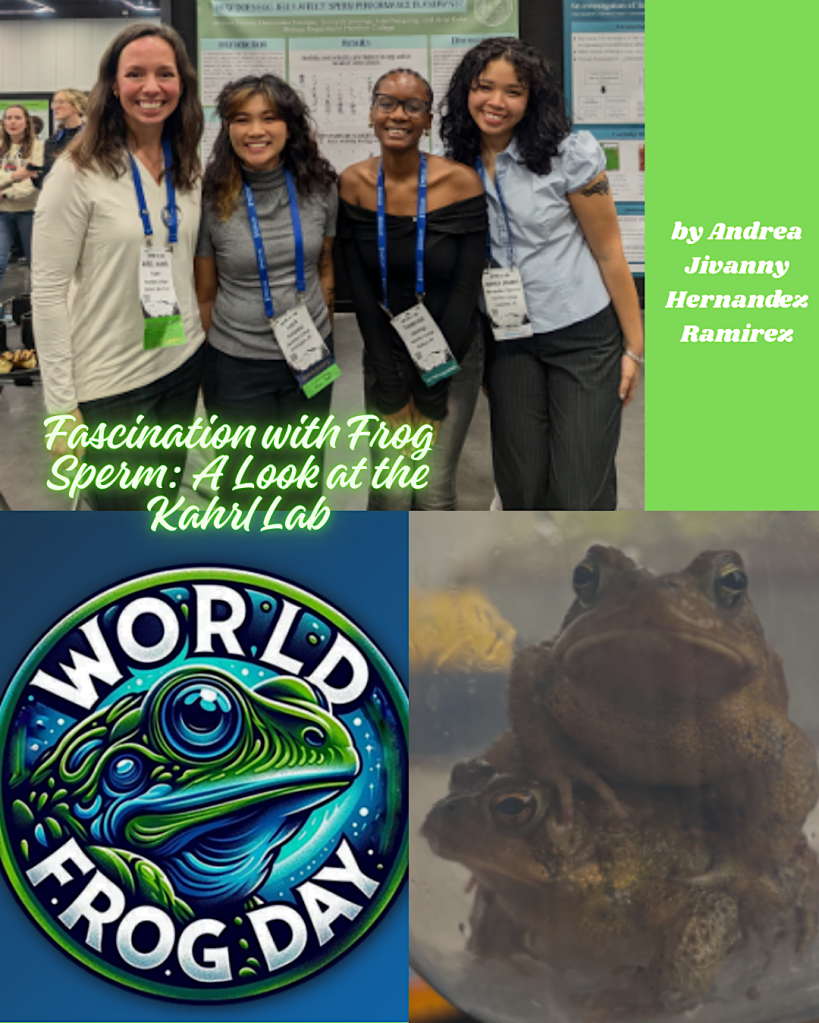
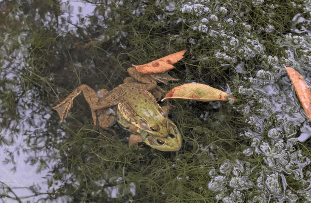
Ribbit, ribbit. Plop. The sounds of the pond at night as we scout for frogs to catch can be soothing, frustrating, but always exciting. The Kahrl lab in the biology department at Hamilton College looks at all things amphibian reproduction. Last summer, the lab researched sperm performance in green frogs. By day the Kahrl lab would collect samples during June at the height of mating season for green frogs. Although I find male green frogs are more of the loud croak than ribbit kind of loud, they are a jumpy bunch. Recently the lab focused its efforts on tracking sperm performance across two media and presented the findings at SICB in January.
The samples collected were of eggs from females, for the purpose of testing media. And of course, sperm from males were the tested samples. Apart from being smaller sperm than those of the average mammal, amphibians’ sperm tail or flagella has its own structure and shape–the undulated membrane. From an evolutionary perspective, the trait is quite fascinating given its ability to disappear and reappear. It raises the question, why does it evolve in the first place? And with that question can we know why it sometimes is lost. A key concept across biology, from proteins to sperm to physiology, is that shape informs function. The undulating membrane is altering swimming mechanics and patterns for amphibian sperm, maybe because of their majority aquatic and external fertilization. What is not known, however, is how the swimming of amphibian sperm with the membrane differs from amphibian sperm without the membrane, let alone from other species.
Crooooaaaaakkkkkk. Crooooaaakkkk. June is a busy time for American toads too. The lab collects data on different male characteristics as well as sperm samples for imaging and flagellar motion videos. While these friends are less slippery, they sure are the loudest lab mates! And the grumpiest. Once over the summer, a toad croaked every few seconds for an entire two hours!
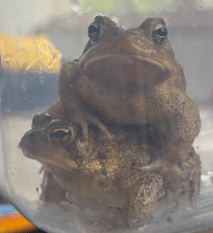
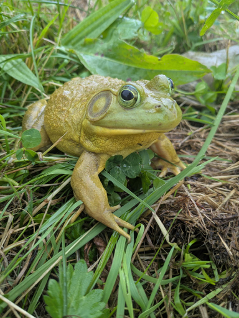
All three of these anuran species have the undulating membranes. Professor Kahrl’s lab continues to work on understanding the trait and why it has been lost and regained several times in anurans. This summer they hope to add parameters related to chemical contaminants as well as physics to study what affects this sperm and how it even functions, along with overall anuran reproduction. While the lab has already done much imaging on the membrane, the mechanics of this membrane and how it affects motion have not been fully studied, and it might just be the key to understanding its evolution.
With climate change on the rise, it is still so important to learn as much as we can about the animals in our ecosystems in order to understand the effects climate change has on their species and populations. As well as give every being the urgency and opportunity to matter in science. Our slimy and warty friends are more than summer night ambient noise, they are complex organisms with secrets we have not yet uncovered.
about the writer:
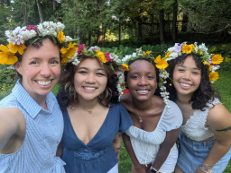
Scientist and Blogger(SICB Mangum recipient) Andrea Jivanny Hernandez Ramirez (On the far right) is a junior at Hamilton College pursuing a B.A. in biophysics with a minor in math. As a poster presenter at SICB 2026, Andrea Jivanny presented on a research project from the summer with Dr. Ariel Kahrl in the Biology department. They were looking at the performance and longevity effects of egg jelly on sperm in green frogs. Since then Andrea Jivanny has begun research on flagellar motion of anuran sperm to incorporate more biophysics in her work.
Andrea Jivanny has previously done scientific translation work for an article published in ICB. Outside of the lab, Andrea Jivanny is a part of Hamilton College’s figure skating team, Student Government Alliance, La Vanguardia (association for latino students), Student Affairs Committee and QuestBridge chapter. In her more personal life, Andrea Jivanny spends her free time reading, writing poetry, and playing Dutch Blitz.
Learn more about Frog Day 3-20-26
read Kahrl et al’s
Relationships between Pre- and Postcopulatory Sexually Selected Traits in Green Frogs (Lithobates clamitans) Op
Integrative Organismal Biology, Volume 7, Issue 1, 2025, obaf040, https://doi.org/10.1093/iob/obaf040
 Integrative Organismal Biology