
Have you ever switched the taxonomic group you are studying? Maybe you’ve switched to a different family group, or maybe even a different order or class?! I recently transitioned from studying Anolis lizards to starting a lab studying the reproduction and sperm biology of frogs. They were a great system, but I knew nothing about them (other than they are extremely cute and charismatic) and desperately wanted a in-depth guide to help me dive into this group of vertebrates.
“The Book of Frogs, second edition” by Mark O’Shea and Tim Halliday is a perfect resource for someone like me who wants an up-to-date, detailed, and engaging introduction to the natural history, taxonomy, and diversity of frogs. This, to me, provides a very accessible introduction that discusses the classification of frogs, their ecology, life history, reproduction, and current impacts on amphibian diversity (diseases and human-mediated effects). It also has expanded and updated new families from Africa and the Amazon and updated taxonomy since the first edition which was published in 2016.
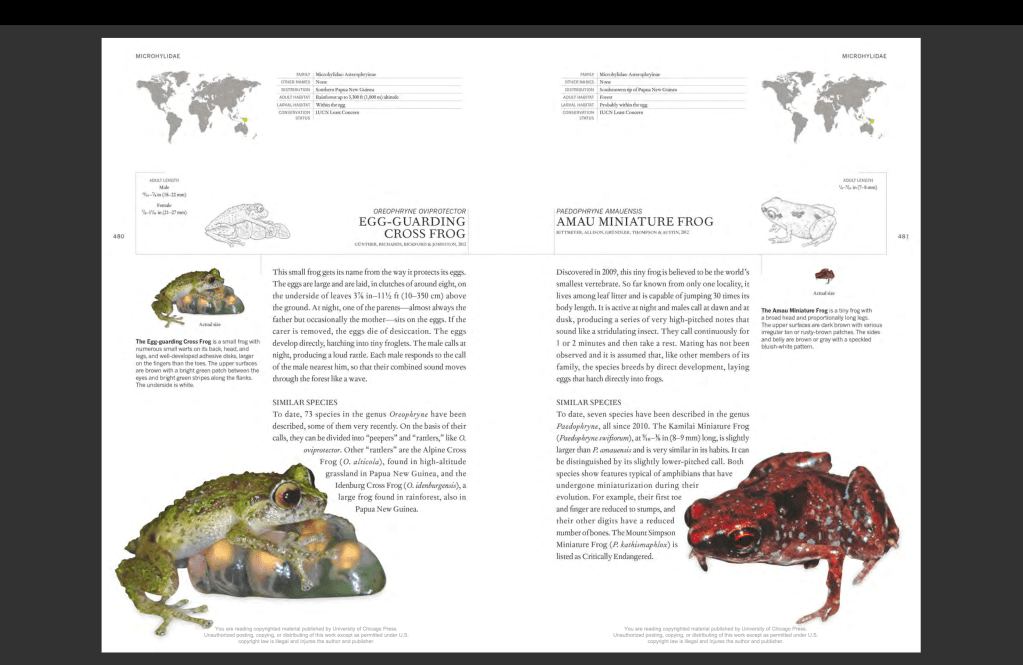
The real meat and beauty of this book are the 600 species descriptions from frogs around the world. Each species has a header that defines their classification, distribution with a world map, habitat, and conservation status as well as a line drawing with body sizes for males and females. Following this are beautiful images that are scaled to life-size (please see Giant African Bullfrog and Gardiner’s Seychelles Frog for impressive frog body size range) with a short caption that describes the frog’s appearance.
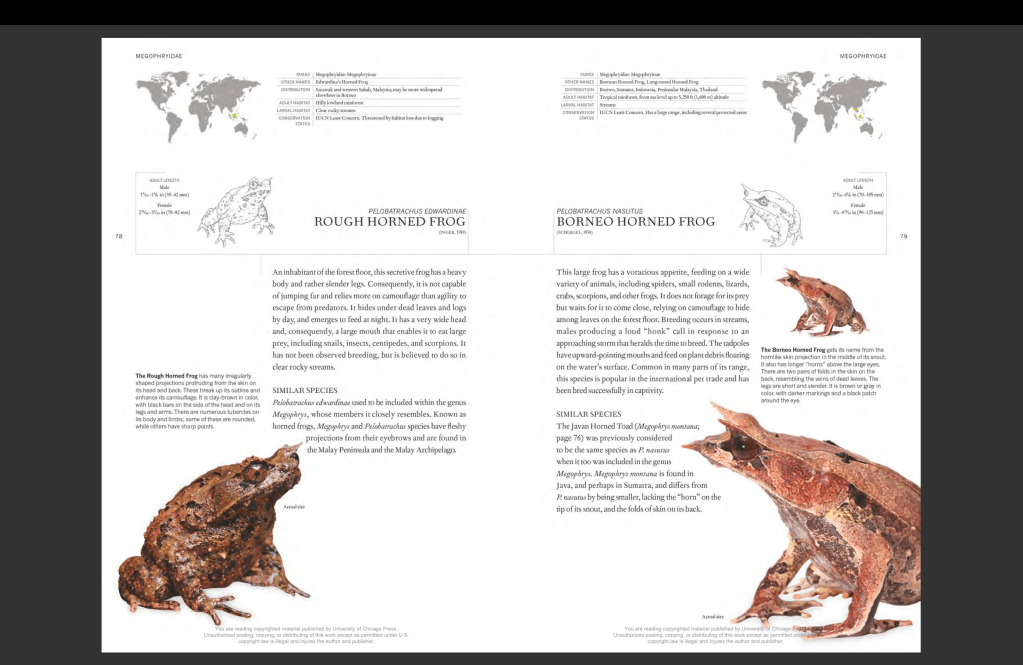
Finally, two paragraphs describe the most interesting facts about the calls, reproduction, behavior, tadpole phase, interactions with humans for each species and descriptions of other similar species, many of which are not highlighted in the book. Examples of some of this wild frog facts:
“ [The eggs] develop in a pouch on the female’s back, each egg within a separate chamber. The tadpole’s gills act like a mammalian placenta, attaching to the wall of the chamber, so that there is gas exchange between the tadpole and the mother’s blood.”
p. 226, Horned Marsupial frog
“When hiding in a tree-hole, either during the day or throughout the dry season, the frog uses its head to block the entrance.”
p. 330, Yucatan shovel-headed tree frog
“This highly unusual frog breeds in very fast-flowing streams…[where] the sound frequencies that males frogs typically use to attract mates would be inaudible. The frog therefore produces ultrasound, sound frequencies that are too high for the human ear to hear, but that are audible despite the sound of rushing water. To hear such sounds, it has highly unusual ears with the tympanum deep inside the head.”
p.551, Hole-in-the-head frog
While a typical field guide might give you descriptive detailed identifiers of species from a specific location, this book distills a huge body of knowledge for each species into these short and impactful paragraphs. The authors O’Shea and Halliday demonstrate their clear love for frogs and their knowledge in each of these carefully crafted pages.
Though a perfect primer for a researcher like me, this book is a tremendous resource for frog enthusiasts of all ages (my 6-year-old stole this book for over an hour while I was reviewing it), but I think is especially aimed at naturalists who want to have a broader appreciation for frogs across the world. Frogs, or anurans, have more than 7,784 species (according to The Book of Frogs), and this book is a carefully curated list of some of the best examples of frog diversity which will give readers a comprehensive view of frogs and their biology. While the species descriptions do not contain citations, the end of the book has a helpful resource guide that includes websites, general reading and other field guides.
As a professor who works with undergraduate researchers, many of whom have never held an amphibian before stumbling into my lab, this book will be our lab’s constant companion, sitting on my office table for students to explore the fascinating world of frogs.
Acknowledgements: I am grateful to Suzanne Miller, Integrative and Comparative Biology’s Managing Editor and Social Media Coordinator, and Chicago University Press for providing me with a copy of The Book of Frogs.
& read
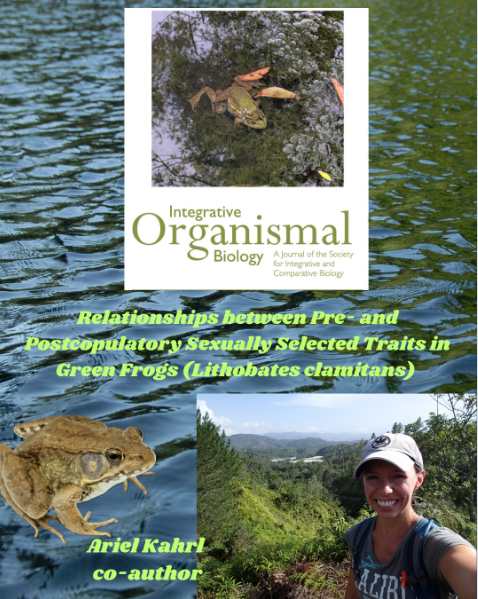
Relationships between Pre- and Postcopulatory Sexually Selected Traits in Green Frogs (Lithobates clamitans) Open Access M O Girard , C J Clark , A F Kahrl
 Integrative Organismal Biology