By Josephine Low, Swarthmore College ‘27 (IOB co-author)
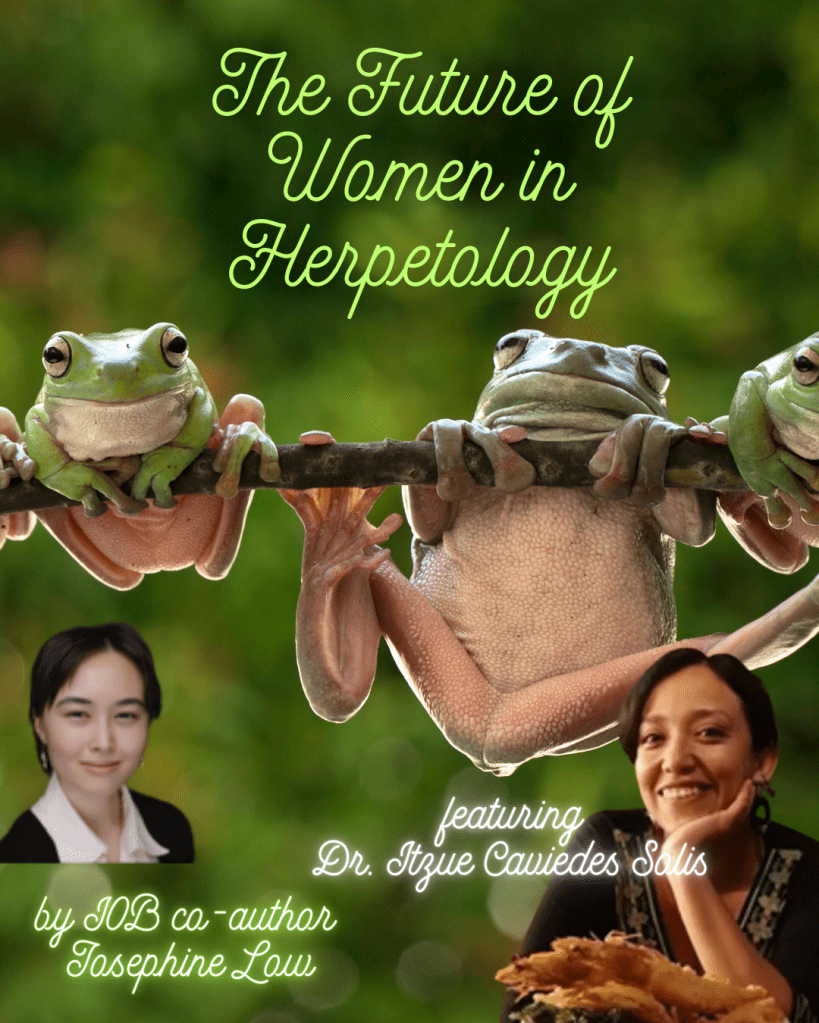
Dr. Itzue W. Caviedes Solis once told me that a frog’s eye contains the entire universe. As a researcher and educator, she has opened up that universe to countless other people, especially through Global Women in Herpetology, which was co-founded in 2020 with fellow scientists Dr. Umilaela Arifin and Dr. Sinlan Poo. According to Caviedes Solis, the idea for a network of women herpetologists first struck on a hike at the World Congress of Herpetology in Dunedin, New Zealand. Herpetology, the study of amphibians and reptiles, must confront a legacy of discrimination and colonial injustice. However, the field has also been shaped by the courage of people who have persevered despite systemic obstacles, and their compassion to uplift those around them. Women in Herpetology is one such reason for hope, especially in an era when science and scientists are under attack.
The COVID-19 pandemic struck shortly after Women in Herpetology’s inception. Rather than stifling the founders’ motivation, the lockdown allowed the project to flourish as an outlet for collaboration while research was forced to pause. A book, Women in Herpetology: 50 Stories From Around the World, was published in 2023, containing short memoirs and portraits of incredible contemporary scientists, including Caviedes Solis, Arifin, and Poo. Along with the project’s success came a website, https://www.womeninherpetology.com/, hosting an ever-expanding directory of women herpetologists from around the world.
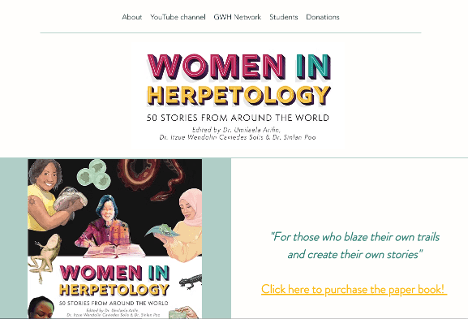
In addition to strengthening community, the directory exists “so people couldn’t use the excuse that they don’t have woman collaborators because they can’t find them,” said Caviedes Solis. About Global Women in Herpetology, she admits, ““When we first started it, we had no idea how much it was going to grow.” Last year, book sales fully funded seven herpetology students to present at the World Congress of Herpetology in Kuching, Malaysia, four years after the World Congress that started it all. To reach an even broader audience, the Spanish version will be released in 2026 and the book is set to be translated to Chinese in the coming years. All the book sales will continue contributing to the students scholarship.
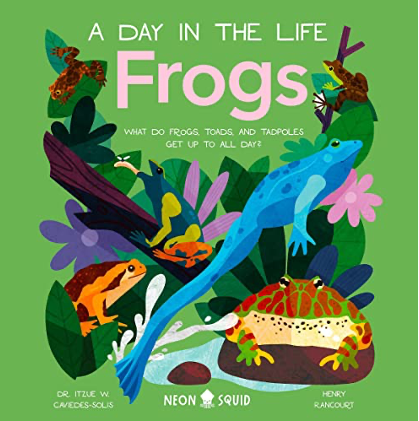
Cavides Solis’s dedication to uplifting others goes beyond Women in Herpetology. She believes, “Outreach is our responsibility. Both as a scientist and as a person, it’s the right thing to do.” Her research at the Tiputini Field Station in Yasuní National Park, Ecuador, and the Chamela-Cuixmala Biosphere Reserve in Jalisco, Mexico, has investigated frog microbiomes, which are major determinants of the amphibians’ ability to survive the pressures of human activity and climate change. At each step of the way, Cavides Solis prioritizes the voices of the community where she works, and the education of students who will carry the future of herpetology. She mentors and trains her students to do science and science communication. In Mexico City, she and her students worked with Universidad Nacional Autónoma de México laboratories, and inspired a love for living creatures in children visiting the university’s museum. She enjoys publishing books about biology for a variety of audiences, especially children’s books. Although writing children’s nonfiction might not be as “shiny” as other milestones in academia, Cavides Solis knows that it’s equally important. As she said, “When we do conservation we need to think about the future, and if we don’t engage with the next generation there is no future.” It’s no exaggeration to say that taking her Conservation Biology class at Swarthmore College forever altered my relationship to science. The feeling of wonder is too often dismissed as a distraction from the data, but Itzue Cavides Solis is a living reminder that it is a powerful way to connect with the natural world, and with each other.
To young scientists, this is her advice:
“Don’t let anyone make you feel like you don’t belong in science. Some people might pressure you to change who you are to fit what they think scientists look like, but I think what makes science very rich is differences of opinion and different personalities, so bring your own personality and ideas instead of trying to fit the mold of what other people think a scientist is. I want to see new generations being themselves, and being creative, and being brave, because that’s what’s really going to change the field – doing something you love and want to do, not what others think you should do.”
And why does she do what she does? “Nature is too cool to ignore. We need to keep working to create a more equitable world for the people and for the frogs.”
Writer and IOB author: Josephine Low , Swarthmore

Josephine (Josie) Low is a junior at Swarthmore College studying biology and environmental studies. Her research has included studying Octodon degus as a model for physiological and developmental responses to water scarcity in the Bauer lab of Swarthmore College, PA, and a summer internship with the Kennedy Lab at Cedar Creek Ecosystem Science Reserve, MN. When not in the lab or the field, you can find her making art or playing with her cat, Foggy.
https://www.linkedin.com/in/josephinesylow/
IOB Herpetology read with a woman in Herpetology as the submitting author:
Winter Is Coming: Integrative Analysis of Cold Acclimation in a Freeze Tolerant Frog Open Access
Elizabeth E Yokum , D L Goldstein , C M Krane
Integrative Organismal Biology, Volume 7, Issue 1, 2025, obaf008, https://doi.org/10.1093/iob/obaf008
& Don’t miss Josephine Low’s coauthored work
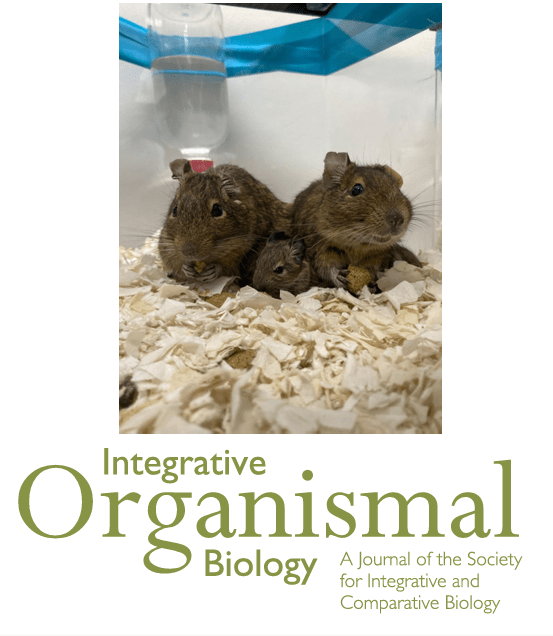
Baseline Testosterone Levels Peak During the Inactive Period in Male Degus (Octodon degus) Open Access
Y Sato , T M S Garcia , J S Low , C M Bauer
Integrative Organismal Biology, Volume 7, Issue 1, 2025, obaf033, https://doi.org/10.1093/iob/obaf033
 Integrative Organismal Biology