Iobopen.com is hosting a series of blogs based on an article from Outside about “Awe” being good for the brain. We asked IOB authors to share their moments of “Awe” in the field. Read our latest installation below by previous IOB coauthor Erin D. Treanore.
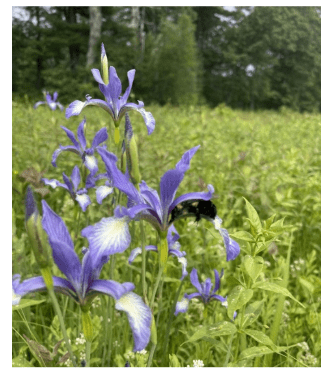
Growing up in Michigan, and then spending chapters of life everywhere from Germany to Pennsylvania and now Massachusetts, the end of winter is something I have come to relish. Spring marks the beginning of many things—forest wanderings, spring ephemerals, longer runs, fresh vegetables, and the slow awakening of seemingly everything and everyone around me. As an entomologist, this springtime awakening has taken on new layers of importance and meaning as I’ve grown to appreciate, and stand in awe of, some of the first insects to announce spring’s arrival: bumble bee queens.

My annual encounter with the first spring queen has varied dramatically across the years, but the sense of awe it brings has remained constant. Appreciating that first queen of spring requires at least a basic understanding of her life cycle. In temperate environments like Pennsylvania and Massachusetts, these queens eclose in their natal colonies in late summer or early fall, mate, and then spend the next 6–8 months in diapause as adults, tucked away underground in a hibernaculum. Come spring, the surviving queens dig themselves out and begin searching for a suitable site to establish a nest.

During my PhD, while my weekdays were spent in the lab working with commercial bumble bee colonies, my weekends took me far from the lab, deep into the wilds of Pennsylvania, searching for patches of trailing arbutus and Vaccinium species. These early-flowering shrubs were often buzzing with activity while the rest of the landscape remained quiet. With each queen sighting, I couldn’t help but pause and think: How lucky am I to encounter this queen, one who has endured the same harsh winter as I, but underground? Her hair, or pile, still looked pristine as she foraged to replenish the nutrients she had relied on through the winter. Her familiar zig-zag flight pattern as she searched for the optimal nest site was a reminder of the annual cycle about to begin—for both this queen and the rest of us. These quiet moments of awe grounded me, reminding me of the natural rhythms around me, present even when I felt disconnected from them.
Understanding how these bumble bee queens survive the winter was a central focus of my PhD research and this IOB publication, where I investigated the role of pollen nutrition consumed pre-diapause. Now, as a postdoc, I study what happens after the winter diapause—spending several months each spring chasing queens through the fields and forests of Massachusetts. These days, I think a little less about pre-diapause nutrition and a bit more about spring queen phenology, but I use these different lenses to think about bumble bee biology more holistically. Now, even though I’ve now seen thousands of bumble bee queens, I still find myself in awe of that first queen of spring.
About me:
Currently, I am a postdoctoral scholar in the Crone Lab at Tufts University where my research focuses on bumble bee life history, phenology, and methods for field studies. I received my MSc and PhD from Pennsylvania State University where I conducted research in the Amsalem lab investigating the ecological and evolutionary implications of diapause in bumble bees. My MSc research was conducted in the Fleischer lab where I investigated how mid-Atlantic agroecosystems could be better managed to support generalist pollinators through refined cover crop practices. Through these different lenses, my research has asked how we can improve the conservation and management of pollinators, namely bumble bees. When I’m not researching them, I can usually be found in the same wild spaces they are, either hiking, running, or climbing.Find out more about me and my work at https://erintreanore.weebly.com/about.html or contact me at etreanore@gmail.com
Read Erin’s IOB co authored work
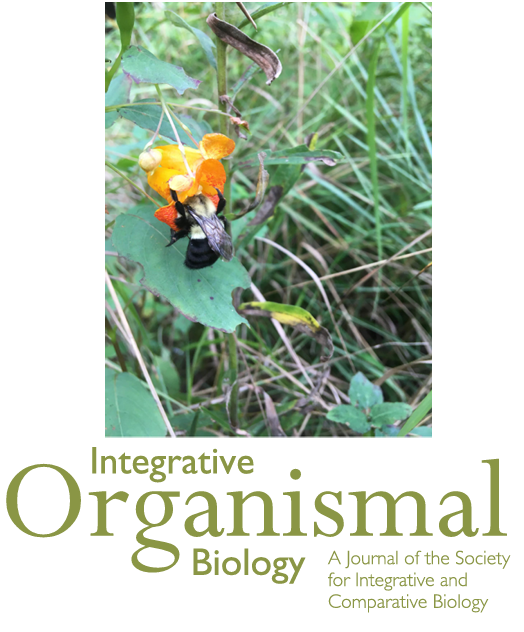
The Effect of Pollen Diet Composition and Quantity on Diapause Survival and Performance in an Annual Pollinator (Bombus Impatiens)
E D Treanore , A V Ramos-Medero , J Garcia , E Amsalem
Integrative Organismal Biology, Volume 5, Issue 1, 2023, obad014, https://doi.org/10.1093/iob/obad014
 Integrative Organismal Biology