National Book Month Blog
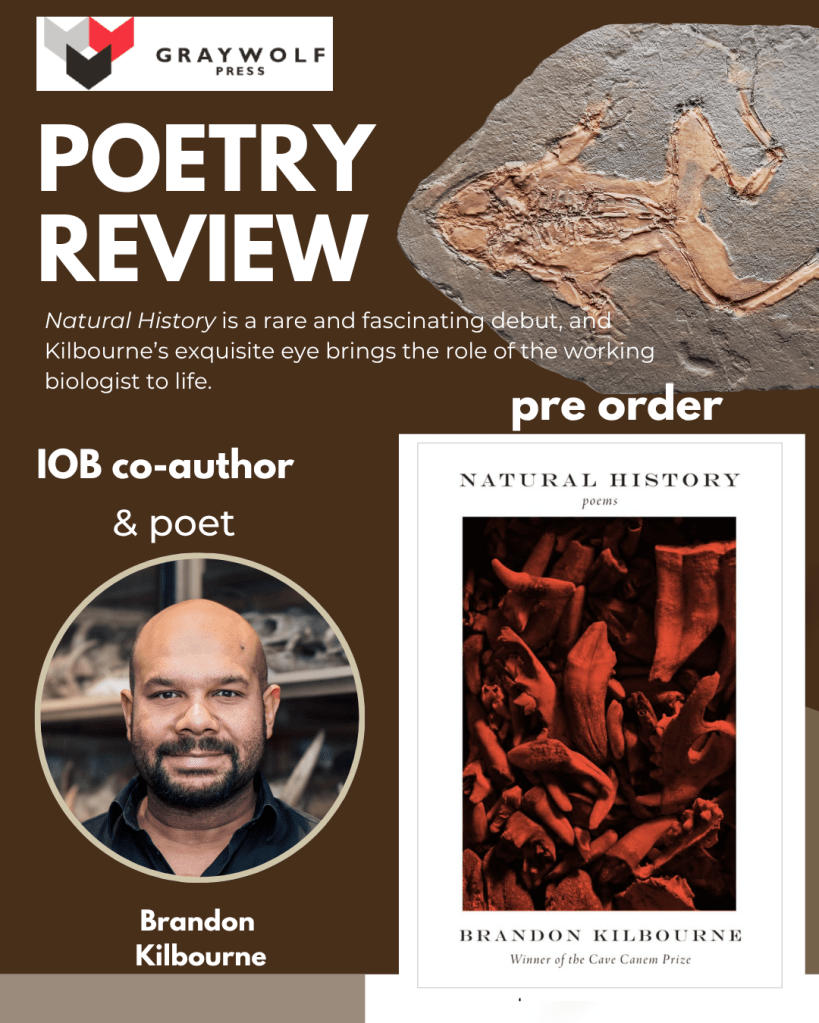
In the poetry collection, Natural History, scientist and poet, Brandon Kilbourne, writes about the origins of everything- species, scientific practices dealing with these species, places they exist and even of himself. He doesn’t just describe them in an equally elegant yet brutally raw way. He lays out their journeys, how they came to be first seen by human eyes, captured to be demeaned or worshipped by human hands, then transported and placed in human structures for human eyes to view. His unabashed account of the colonialism that is at the root of American science ( and in actuality,science at large) is a needed offering in these precarious, past-denying and somewhat anti -intellectual times we find ourselves in.
I had many favorite poems throughout the four sections that the book is divided into. I will detail a bit about only a few poems, at least one from each section:
Section 1- The Curious Institution
In the second poem of this section, “Natural History, the Curious Institution,”Kilbourne beautifully, yet tragically depicts the way that the early sciences were inextricably linked to the slave trade. He opens with a stanza putting us in the cargo hold along with soon to be slaves and alternates this experience with descriptions of specimens brought aboard as well as testimonials of the crew. There is no doubt, after reading this initial offering, that the rest of the book will hold hard truths intermingled with exquisite observations.
Artist, lyricist and musician, John Lennon, was quoted as saying “An artist’s job is to show the world to itself”. This first poem lets the reader know Kilbourne is equipped to do so.
Section 2- The Memory Museum
This section puts us in touch with Kilbourne’s experiences with not only the natural world but with his family, and others in his orbit. “Boyhood’s Fields” is a standout for me as many of us can relate with the inability to fully understand the cares and concerns of the generation before us.
“as we drove down a road like a fault line dividing small farms and their differing crops. And so those fields remain empty to me, their furrows forever blighted by the mouthfuls of salt you sowed among their soil.”
With phrases like the above, we get a glimpse of what might’ve ignited Kilbourne’s curiosity about species and the world at large. Possibly the rift between him and his own assigned world, the disconnect, sent him searching and like many great poets before him, he identified with the displaced and disenfranchised.
Section 3 – Dispatched from Ellesmere
I didn’t know much about Ellesmere Island until recently when I received another book from a press to have reviewed about the wolves who make a home there. In this section Kilbourne introduces readers to this unique and confounding landscape with verses like “Ellesmere Elegy.”
“This land stages parables:
a lone caribou, its coat the color
of fog, curiously approaching humans.
This land emanates awe:
after a storm, the sun blasting its rays
through the sargassum of silvered clouds.
This land divulges ghosts:
among outcrops, the bones of dead life
forms weathering out of solidified silt.”
Kilbourne’s poems emanate an equal amount of awe as Ellesmere and we are honored to accompany him on this expedition without ever having to leave home.
I’d be remiss not to mention “Eggshell Future”in this section also as it encapsulates the gist of much of this collection. In this simple poem a bird defends its eggs from a clumsy intruding human. Indeed, many of the poems revolve around this scenario- humans adversely affecting nature, and nature’s meager, often ineffective warnings.
Section 4 – Blindfold Wonder
In the last poem of the collection, “Blindfold Wonder,” Kilbourne gives us a look into his first interest in the world around him. The title refers to the childlike wonder we all carry initially. He also ventures into this identifying with rare species, feeling a bit like a rarity himself.
“Though not invisible, I remain a rarity, and – as any
trophy hunter could tell you- rarity all too often merits
a target on your hide, as when a revered graybeard
takes aim with his seminar topic – Black people
are not as smart as white people – his erudite racism
challenged by averted eyes and silence, just as when
among attic antlers, a curator makes time to shoot
her question- Who are you and what do you think
you’re doing ?-blind to your dangling visitor’s badge
or when, in your head, out creeps the voice
of a craniologist hunting in the nineteenth century –
Whom could I perhaps pay now, so I can collect
his skull and measure its volume after his death? –
Despite the shelter found in deadening your retinas,
steadfast wonder does little to deafen your ears. “
Though Kilbourne’s poems are reminders of the fragility, yet persistence of nature and all its glory, we are left to wonder if perhaps the whole book is an elegy? Kilbourne seems to yearn for not only the natural curiosity and wonder he fell in love with as a child, species gone by, but he also mourns a world that has never appreciated them, and maybe even him for that matter, the way they truly should be.
Perhaps it is easier to stomach harsh realities by way of poetry? Possibly Kilbourne has chosen one of the most beautiful genres so we read on and don’t turn away from being reminded of what carnage man has waged, and continues to wage, upon the world. Just maybe Brandon Kilbourne’s poems are a bit like the specimens behind glass that he refers to – luminous, sad, and yet so spectacular in their own way.
Connect with Brandon (@) brandon_kilbourne_poetry on Instagram
Watch his SICB YouTube.
and read his IOB paper :
Functional Morphology and Morphological Diversification of Hind Limb Cross-Sectional Traits in Mustelid Mammals
Open Access
P Parsi-Pour , B M Kilbourne

 Integrative Organismal Biology