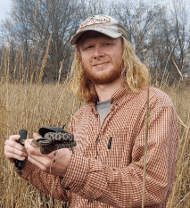
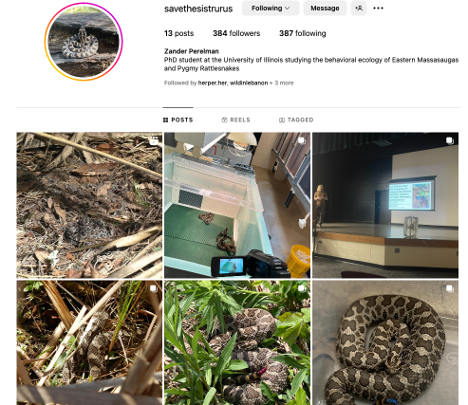
We asked coauthor Zander Perelman, PhD student at the University of Illinois studying the behavioral ecology of Eastern Massasaugas and Pygmy Rattlesnakes, to expound on his academic journey and his co authored
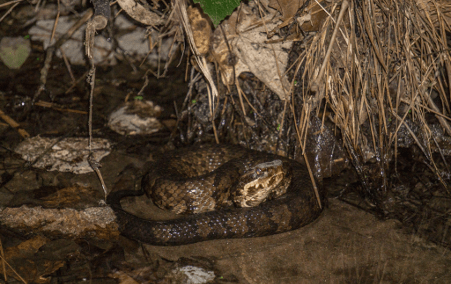
On the biographical side, tell us about what led you to your focus of behavioral ecology and in particular the Eastern Massasaugas and Pygmy Rattlesnakes?
I’ve always been interested in the natural world, and snakes in particular. As an undergraduate at Bucknell University I majored in Animal Behavior, and I became fascinated with trying to better understand snake behavior, particularly as it relates to a species’ foraging ecology. My MS research focused on Eastern Massasaugas in Pennsylvania and now as a PhD student I work with Eastern Massasaugas in Illinois. Pygmy Rattlesnakes became a focus of mine early in my PhD, as they are in the same genus as Eastern Massasaugas (Sistrurus) and present an opportunity for interesting comparative studies. Overall, Sistrurus rattlesnakes are understudied, especially behaviorally, and a goal of my dissertation research is to greatly expand our knowledge of the behavioral ecology of these two species.

What literature sources and or instructors have helped you the most in your scientific journey?
For literature sources, it’s hard for me to narrow it down as I have tried my best to immerse myself into all available published papers and books related to my areas of research interest. I recommend any other young academic does the same, as knowing and reading the literature is a great way to develop and refine your scientific approach and technique. As for instructors, I’ve been lucky to have some great mentors throughout my academic career, including Dr. Bill Lutterschmidt (the first author on this paper).

As an undergraduate, I was a part of Dr. Mizuki Takahashi’s lab at Bucknell University, and Mizuki played a major role in getting me into research and on the path to graduate school. From there I went to Sam Houston State University to work with Bill for my MS. Along with Bill, I was incredibly fortunate to have Dr. Howard Reinert (from The College of New Jersey) serve as a research advisor. Howard had always been a role model for me, and my experience with him as a mentor has been invaluable for me as a young researcher and academic.
What would you say are some of the challenges in the type of research that you perform?
One of the biggest challenges with my research is simply finding enough snakes for an adequate sample size, particularly when doing field-based studies, as the species I work with are often incredibly cryptic and occur at low abundances. Another challenge broadly associated with my research is that there is often less funding available for studies of snake behavioral ecology compared to other taxa. There is also the inherent risk of working with venomous snakes, although following proper protocols helps to ensure that snake-human interactions are always as safe as possible. Ultimately, I think the challenges with my research are similar to many other systems, and for me, they do not have a negative impact on my passion and desire to continue to pursue the research ideas and questions I am interested in.
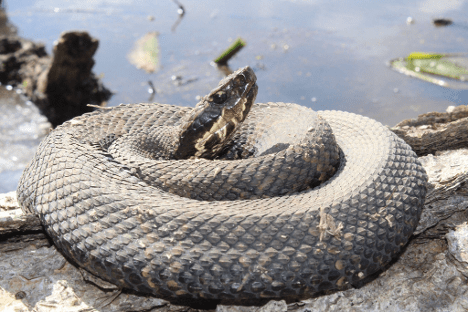
Can you tell us a bit about the choice to use a foraging generalist as an alternative experimental model to investigate if specific year-long experienced-based diets could influence prey preference ?
Many previous studies of prey preference in snakes used species with specialized diets, making it likely that a prey preference of some sort would be expressed, which was often, but not always, the result. We decided to use Cottonmouths to explore prey preference because we would expect that as foraging generalists, they would not show a preference for a certain prey. However, by feeding snakes a specific diet (either fish or mice) for a year, we could explore how experience potentially impacts prey preference in this species. Our study system allows for an interesting comparison between previously tested specialists and our tested generalists. Ultimately, we saw that Cottonmouths, regardless of diet group, showed no clear prey preference, providing further evidence that these snakes truly are generalists.
What surprised you most about the results of your study?
Surprised is likely not the right word, but I think one of the interesting results is that the Cottonmouths from the field-diet group that were brought into the lab and tested without any diet manipulation showed a lower tongue flick response compared to the Cottonmouths that had been kept in captivity and had long-term diet manipulation. Although tongue flick responses were lower for field-diet Cottonmouths, they showed the same prey preference, or more accurately the same lack of prey preference, as the mouse fed and fish fed Cottonmouths, providing further evidence that prey “preference” in Cottonmouths is under genetic influence and not strongly impacted by previous experience.
Without giving too much away, can you explain some of what you’re currently working on and how it relates or differs to this study?
My research spans a few different areas of behavioral ecology, for my dissertation I’m studying antipredator behavior, agonistic and reproductive behavior, foraging behavior, and behavioral lateralizations. The Cottonmouth prey preference study has been very impactful for me, and I do intend to conduct more prey preference experiments with a few different pit viper species in the future, but those experiments likely have to wait until I have a full time position and lab. In the meantime, I have begun to use field videography to study the foraging ecology of Cottonmouths in the field to get a better understanding of their behaviors and the factors that influence their foraging success. My current videography work with Cottonmouths is a direct offshoot from my experience with Bill and the Cottonmouths back at Sam Houston State, where this study was conducted.

Connect with Zander via Insta or Facebook
 Integrative Organismal Biology