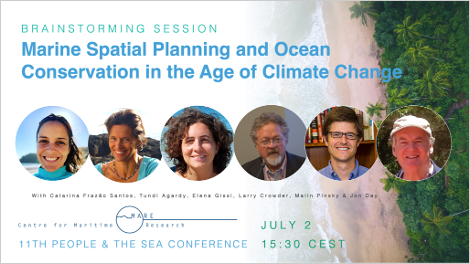
Over recent years, recognition of the need to develop climate-smart marine spatial planning (MSP) has gained momentum globally. In this roundtable discussion,Ocean Planning and Conservation in the Age of Climate Change: A Roundtable Discussion , IOB authors used a question-and-answer format to leverage diverse perspectives and voices involved in the study of sustainable MSP and marine conservation under global environmental and social change. They intend for this dialogue to serve as a stepping stone toward developing ocean planning initiatives that are sustainable, equitable, and climate-resilient around the globe.
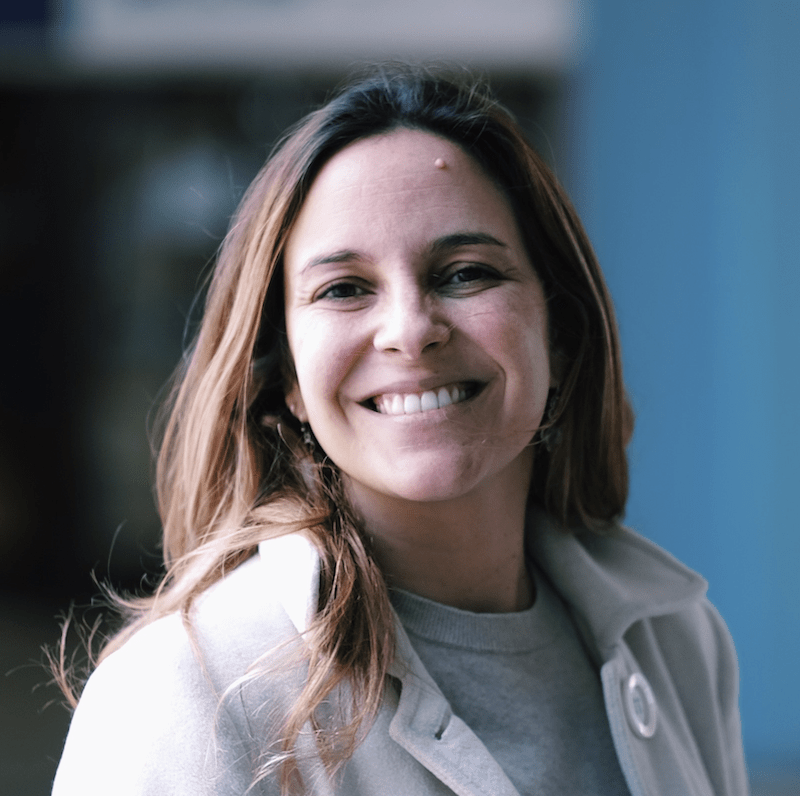
Coauthor Catarina Frazão Santos answered a few of our questions about this work below.
With this being a round table discussion, can you give some of the back history about what brought this particular group of you together at the People and Sea conference?
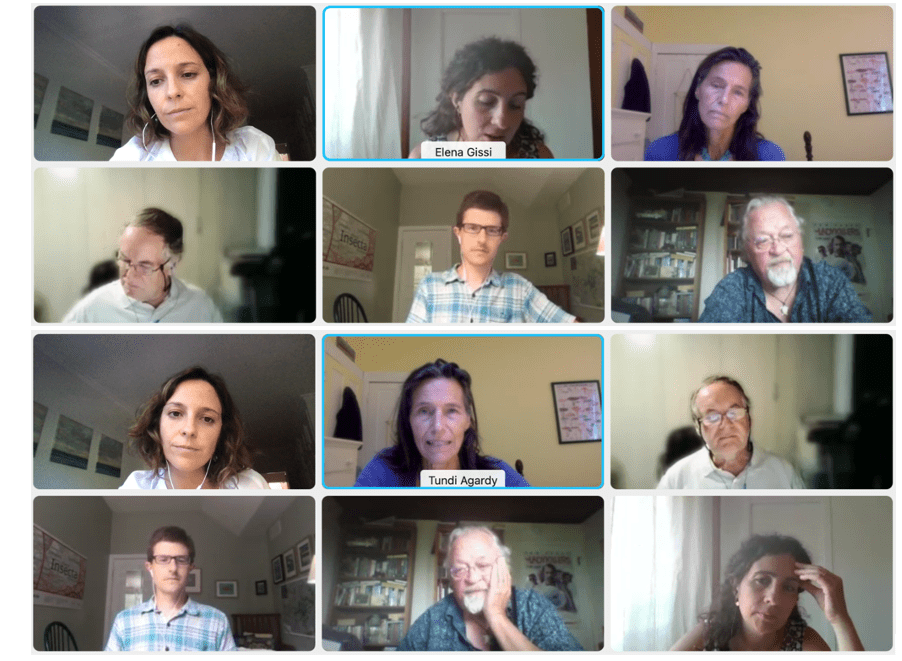
At that time, some of us were already working together on the interlinks between marine spatial planning (MSP) and climate change for some years. For example, Tundi Agardy (an internationally renowned expert in marine conservation), Larry Crowder (a professor at Stanford Doerr School of Sustainability), and I worked on an initial publication on the topic in 2016 (Nature Geoscience). Also, Larry, Tundi, and Elena Gissi (a Senior Researcher at the National Research Council of Italy and Marie Sklodowska Curie Alumni) were members of project OCEANPLAN (“Marine Spatial Planning under Climate Change”) that I was coordinating at the time. We felt, however, that there was a need to debate these issues more thoroughly, so we organized a brainstorming session at the People and Sea Conference (supported by project OCEANPLAN). We wanted to promote a critical debate around the multiple pathways, challenges and benefits of developing MSP initiatives with a conservation foundation in the age of climate change. And to raise awareness of marine managers, planners, and policymakers to the relevance of the topic. But we wanted to have multiple voices, perspectives, and ideas at the table to enrich the discussion. So we invited Jon Day (former director at the Great Barrier Reef Marine Park) and Malin Pinsky (professor at the University of California Santa Cruz and expert on ocean life and climate change) to join us. In the end, some people attending the session also participated in the discussions: Amber Himes-Cornell (fishery officer of the United Nations Food and Agriculture Organization) and Julie Reimer (senior policy/economic advisor at Fisheries and Oceans Canada). And that is how we ended up with this particular group of people.
In the paper you detail that “To respond to these changes while effectively supporting sustainable and equitable ocean use, MSP initiatives will need to be “climate-smart”,. Can you tell us a bit about how past efforts might not have been as climate smart and if you feel things are moving in the right direction to make them more so?
To date, marine spatial plans have largely dismissed climate change as a key challenge. This happened for a diversity of reasons (from additional initial costs to the uncertainty of future climate predictions), and with few exceptions, plans ended up only mentioning the need to address climate change in their objectives but not integrating climate considerations in a practical way. While we still don’t have a plan that we can truly consider to be climate-smart, over the last few years, the concept of climate-smart MSP has gained attention and momentum globally. The concept was highlighted by UNESCO and the European Commission (as one of the six key priority areas of their joint MSP roadmap), the World Bank, and other international organizations. Also, a recent publication (npj Ocean Sustainability) identifies ten key components of climate-smart MSP, so that at a practical level, marine managers and planners have the needed guidance on how to put the concept into action. It is thus most likely that, in the near future, marine spatial plans will start to properly integrate climate considerations.
What initiatives or groups do you feel are doing the best at meeting some of the challenges that climate change can pose to MSP?
At the international level, the MSPglobal initiative, by UNESCO and the European Commission, and the ICES Working Group on Marine Planning and Coastal Zone Management are making important contributions to raise awareness on the topic (most recent initiatives are listed in our paper — Table 1). At the national level, specific MSP initiatives such as those from the United Kingdom, Sweden, or the Netherlands have clearly considered climate adaptation and/or climate mitigation aspects. Finally, several ongoing or recently concluded international projects address the challenges and opportunities that climate change can pose to MSP: OCEANPLAN, MSP-GREEN (EU Member States), MSPACE (UK), PLAnT (Antarctica and the Southern Ocean). So progress is taking place!
Post authoring, was there anything left on the cutting room floor that you wish you’d included in the paper? If so, why did you feel you needed to cut it?
I believe everything that was relevant, all the important parts of the story that we wanted to tell, were kept in the paper. Sure, we had to edit the text significantly from the original discussions and reorganize some sections to avoid repetitions. But in the end, the core message and the insightful and thought-provoking analogies that give life to this piece and make it different and compelling were kept. So, we authors are most happy with the final result. And we are equally grateful that IOB agreed to give us the space to do this in such an unorthodox (question-and-answer) format for a scientific paper!
We’d love to know about what you’re currently working on. Can you tell a little about it?
We are focusing on the Southern Ocean as a testbed for the broader application of comprehensive climate-smart MSP around the globe!
We are doing so under project PLAnT (“Planning for Sustainable Ocean Use in Antarctica under Global Environmental Change”). PLAnT is a 5-year research project funded by the European Research Council (ERC; Starting Grant of 1.5 M €) that started on March 1, 2024. Its overarching goal is to investigate the benefits and challenges of developing a comprehensive climate-smart MSP initiative in Antarctica and the Southern Ocean. To that purpose, the project has five building blocks, using a variety of methodologies from natural and social sciences: identifying existing conditions and pressures and areas most prone to change; imagining multiple futures, using climate modeling and building narratives and scenarios with stakeholders; identifying climate actions to be supported through planning, and ways to ensure dynamic and flexible governance; unraveling political, social, and economic factors that can leverage or hinder MSP development in the region; exploring the transferability of lessons learned to other areas.
PLAnT brings a unique opportunity to inspire nations all around the world on new pathways to plan for sustainability and equity in a changing ocean. It can guide decisions on how marine resources can be used sustainably even as the world changes, providing a model for international and national waters everywhere.
While the core project team is based at the University of Lisbon (CIÊNCIAS ULisboa), PLAnT is supported by an Advisory Board composed of experts from around the globe, with multiple backgrounds and a variety of expertise related to the ocean in general and Antarctica in specific.
So, over the next five years, we will work collaboratively on this (myself as project coordinator and many co-authors as Advisory Board members, such as Tundi, Larry, and Elena). It is a daunting challenge, but if there is a chance to take ocean sustainability one step forward, then it is worth all the trouble!
 Integrative Organismal Biology