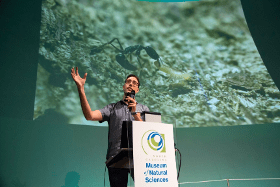
IOB coauthor , Adrian Smith, is the head of a Research Lab at the NC Museum of Natural Sciences where he is jointly appointed faculty. He is an entomologist focused on insect behavior and natural history. He also produces science media (YouTube channel Ant Lab) and studies how science is communicated to public audiences. https://www.youtube.com/antlab
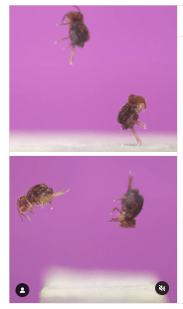
Given Adrian’s unique skills in utilizing digital media to spread the word about science and his research, we asked if he would lend a bit of that expertise to our readers via this interview below.
How have you seen science communication change since you entered academia?
When I was a graduate student social media was just beginning. YouTube was just a year old and we all still had and used MySpace pages and LiveJournals. Communicating science to public audiences was mostly through traditional media routes like press releases, news media/journalism, and print media. Those traditional routes are still very important and useful. However, social media and the self-publishing it facilitates has quickly risen to be another primary means of communicating science to public audiences.
What implications do you feel these changes have for today’s scientists?
In some ways, it’s easier to find a public audience interested in science. In other ways, it has demanded more from scientists themselves if public communication of their work is one of their goals. If your science isn’t being shared or communicated in the way you’d like or is not reaching the audience that you think it could, social media can be a means for doing those things. But that type of direct communication with an audience requires your direct time, effort, and vision. It’s different from institutional-produced or traditional media in that you are not likely to have editorial or production help. That can make it more challenging to produce things, but at the same time you have the opportunity to say what you want, however you want to say it.
Which or your platforms are you partial to and why?
I concentrate on producing video-based media to communicate science. So, my first thought for most of what I make is YouTube. Since vertical short-form video has become popular in the last few years, I am also making things for Instagram, and the YouTube shorts feed. This content was also going to TikTok, but political uncertainty around that platform has made me pause uploading there. I also repackage my video content to run on a local broadcast PBS show in North Carolina, SciNC. I just finished my 5th season as a contributing producer for that show. Being able to take something that started and was made for social media over to broadcast television media really demonstrates how the whole communication media field has dramatically changed and given people like me more opportunities to contribute.
Describe for us a time that using social media and digital platforms caused your work to reach further than you’d ever imagined. Did that change the focus of your teaching or research?
Media production has changed how I define my scholarship. I don’t view my science communication work as broader impacts of my science, or as something I do after I do my science. It is a core part of what I do as a scientist, part of my primary output. For me, making things for a public audience is just as important and worth doing, as a scientist, as making work for peer scientist audiences. It took me a while to get to an understanding of this and really acting on it, but I think I’ve been in that mode for several years now and I’ve found it really a personally rewarding way to work in science.
How does your work with the N.C. Science Museum enhances your other work, and how would you recommend that scientists can get more involved with their local science museums?
The mission of our museum is to “illuminate the natural world and inspire its conservation”. I think illuminate and inspire are pretty good action words that describe what a public-facing scientist might try to do. So, even though I am a museum scientist without a collection and no curatorial duties (we don’t have an entomology collection at our museum), I still think my work matches both aspects of our museum’s mission pretty well. As for what others can do relative to museums, museums should be places for people to share their stories in science as much as they are places for exhibiting facts and specimens. A lot of museums, including mine, put on science cafés, public special events, pop-up exhibits and talks that are all opportunities to introduce yourself and your science to interested public audiences. Most people can’t name or have never met a living scientist. When you present your work to public audiences you, of course, share interesting insights from your research. But you also are providing people one of the few opportunities they have to meet and talk to someone who does what you do. That aspect can be just as important and impactful as the information you are presenting.
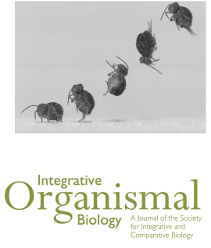
Read Adrian’s coauthored IOB paper
Jumping Performance and Behavior of the Globular Springtail Dicyrtomina minuta
A A Smith and J S Harrison
Integrative Organismal Biology
Connect further
Links
Instagraminstagram.com/dradriansmith
TikToktiktok.com/@antlab1
 Integrative Organismal Biology