Things vibrate all around us. Our phones vibrate constantly; buildings and bridges vibrate in response to wind and traffic; and even our steps shake the ground beneath us. Animals also experience vibrations, and some use them to inform important life decisions. Leaf frog embryos, for example, in the subfamily Phyllomedusinae (Anura: Hylidae) are masters of sensing and using vibrations that travel through their egg clutches. The famously photogenic red-eyed treefrog (Agalychnis callidryas) and their explosive-breeding cousin the gliding treefrog (A. spurrelli) are among a few that have been relatively well-studied. With only a few days of life experience, these embryos can hatch prematurely to escape snake predation, cued by vibrations that travel through their egg clutches. Snakes can eat up to 50% of egg clutches at some sites, meaning attacks are common threats to developing embryos.
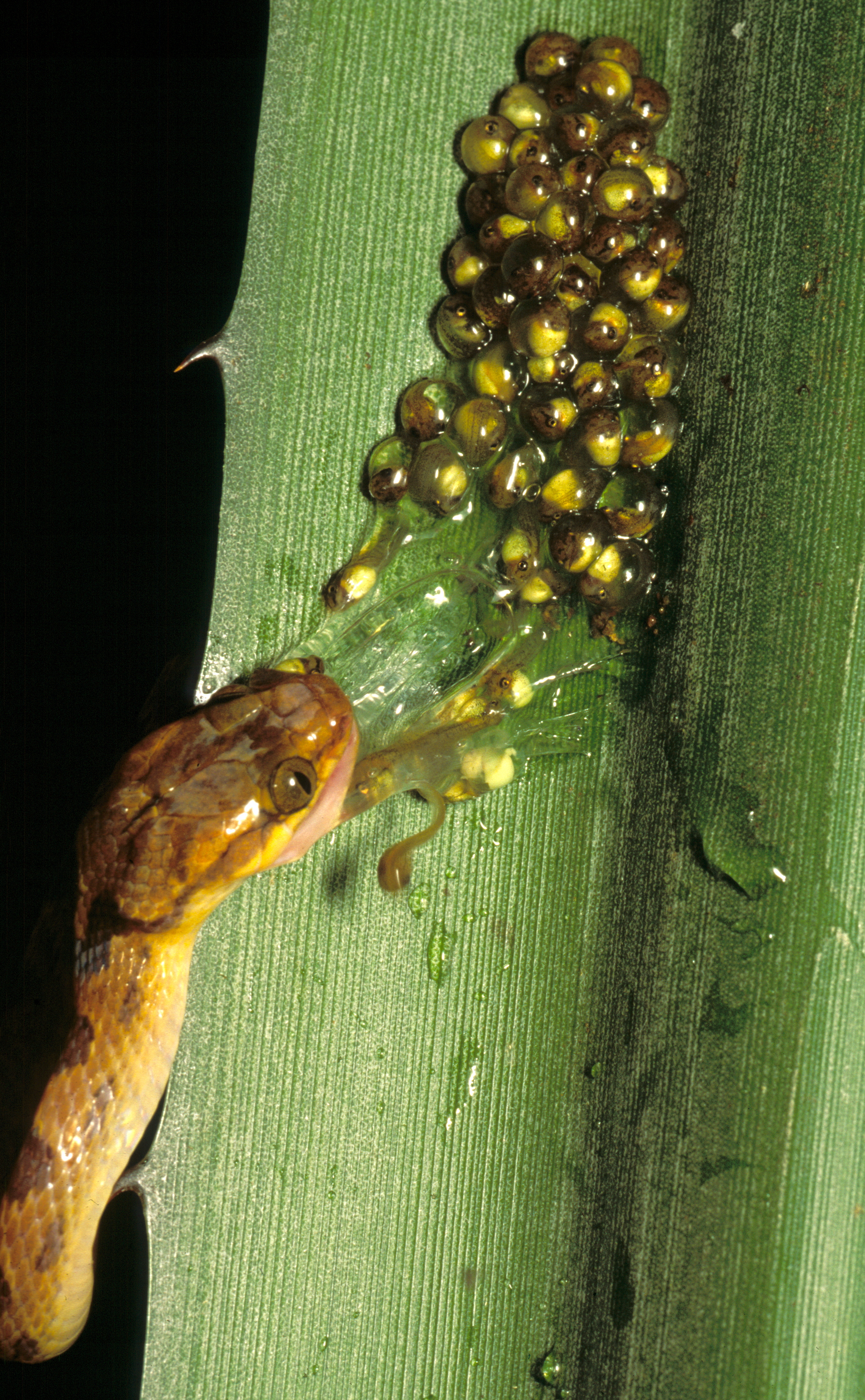
These embryos don’t just hatch in response to anything that jiggles or shakes their clutch though. Incredibly, they can distinguish rainstorms—which are common and benign—from dangerous snake attacks. They do so using multiple vibration properties, like frequency and temporal pattern.
However, not all leaf frog egg clutches are the same—some (like those of red-eyed treefrogs) are thick and gelatinous like a piece of clear JELL-O with green boba on a leaf, while others (like those of gliding treefrogs) are thin and stiff like a mat of small rubbery green marbles stuck on a glue trap leaf.

These different types of egg clutches are also associated with different rates of escape during attacks—red-eyed treefrogs have high escape rates while gliding treefrogs have really low escape rates.
This begs the question: Why do gliding treefrogs suck at hatching to snake attacks?
Not hatching during a snake attack seems silly—why not use a highly adaptive and effective antipredator strategy if you can? Our hypothesis: Egg-clutch structure affects the vibrations that propagate through clutches and thus how embryos perceive and respond to them. In our recently published paper in Integrative and Organismal Biology, we tested the role of egg-clutch structure on escape hatching in three ways.
First, we compared a few basic ‘free vibration’ properties of red-eyed and gliding treefrog egg clutches. ‘Free vibrations’ are basically the residual jiggling of JELL-O after you take a spoonful or that egg clutches experience after a snake bites off some eggs. We primarily did this using a mini wrecking ball-type of pendulum to ‘thump’ clutches head-on in a standardized and repeatable way while we measured their free vibration frequencies and decay rates (among other things) using a small egg-sized accelerometer that we placed inside each clutch.
Free vibration frequencies essentially tell us how ‘scary’ vibrations are—we know that lower vibration frequencies are ‘scarier’ to red-eyed and cause most embryos to hatch in vibration playback experiments. Decay rates are also informative—they tell us how long vibrations persist in egg clutches, essentially telling us how long embryos may be able to sense and assess vibrational information. Our egg-clutch thumping helped us learn that gliding treefrog’s thin and stiff clutches had way higher free vibration frequencies and much greater decay rates—meaning that the vibrations gliding treefrog embryos experience are not only very short lived, but that they are also probably not that ‘scary’!
Second, we wanted to see if egg-clutch biomechanics could directly affect escape rates. So, in what was probably the world’s first ever frog egg-transplant, we carefully removed gliding treefrog eggs from their clutches, ‘de-jellied’ them by removing their tough outer jelly capsule, and then transplanted them into red-eyed treefrog clutches. Our goal was to put gliding treefrog embryos in the same physical environment of their cousins the red-eyed treefrog.
After a day or two of developing within their new host clutch, we exposed the transplanted gliding treefrog embryos to snakes and measured their escape rates in attacks. Our transplants were a success! And as for the ‘patients’? Well, most of them survived—by which I mean most of them hatched in their new host egg clutches. In fact, transplanted eggs had nearly three-fold higher escape success than their sibling controls in typical thin egg clutches!
Third, and lastly, since gliding treefrog egg clutches hardly have any ‘collective jelly’ and egg capsules are so tough and rubbery, we also wondered if the structure of individual egg capsules contributes to hatching responses. We tested this by scrambling up some eggs jiggling ‘de-jellied’ and control gliding treefrog eggs (like in this video) and measuring if and how fast they hatched.
Other than being fun to perform, say, and write, egg-jiggling simulates the vibrations eggs may experience during snake attacks, allowing us to provide a standardized simulated-attack cue on individual eggs. You might think that any embryo would want to escape being poked, rolled, and probed by some giant researcher. This was the case for de-jellied eggs—we found that they not only hatched more often but that they also hatched faster than their control siblings!
The world is full of things that move, shake, and jiggle. As humans, we often take these sources of information for granted, but for leaf frog embryos and many other embryos too, vibrations play a key role in determining when to enter a new life stage. So, why do gliding treefrogs suck at hatching to snake attacks? Ultimately, it may not be that they are ignoring the calls, but rather that they just aren’t coming through… and it seems that egg-clutch and egg-capsule structure are at least partially to blame for their ‘missed calls’.
Brandon received his PhD in Biology from Boston University in 2023 and is currently a Postdoctoral Research Associate at the Institute of Environment at Florida International University. He has a profound interest in natural history, ecology, and animal behavior and believes that integrative field biology and natural history observations are critical in developing hypothesis-driven research that expands our understanding of the biodiversity in our natural world. Brandon is also an award-winning wildlife photographer who believes photography plays a key role in science and conservation communication. Find out more about his work at www.brandonguell.com, follow him @brandon_guell, and contact him at bguell@fiu.edu.
 Integrative Organismal Biology